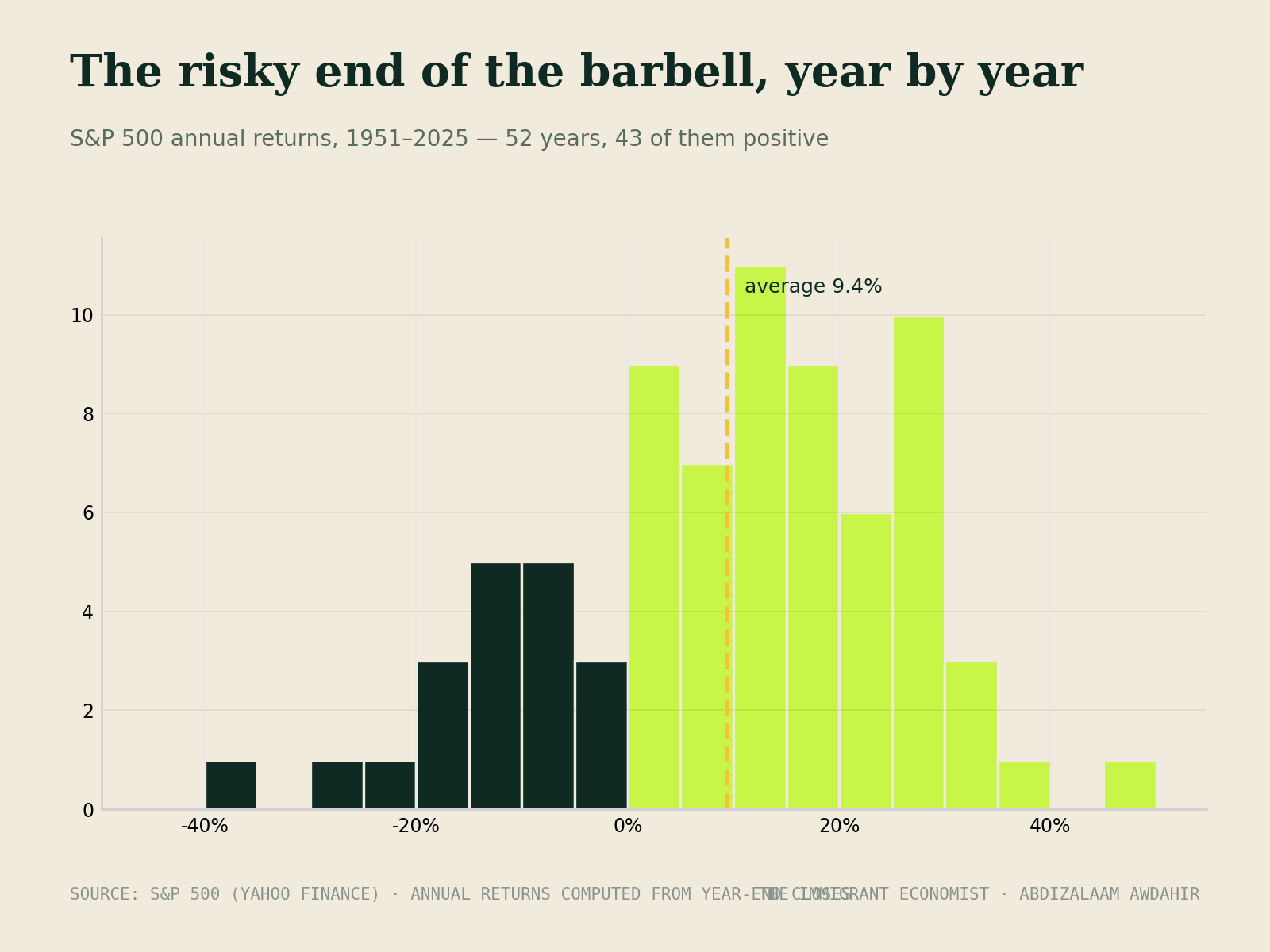
Picture a barbell — the kind in a gym. Weight on one end, weight on the other end, and nothing in the middle but a bar. Now imagine your financial life built the same way: one end extremely safe, the other end open to big opportunity, and the middle — the place where almost all financial advice tells you to live — deliberately empty.
That image is the heart of Nassim Taleb's investment philosophy in Antifragile, and it confused me at first. Surely the sensible place for money is the middle? Medium risk, medium reward, a 'balanced portfolio,' moderation in all things? That is what the brochures say. Taleb's answer is one of the most provocative claims in modern finance: the middle is where fragility hides. Let me explain why, and then — more importantly — how an ordinary person, an immigrant building a first financial life in the West, can use this idea without touching a single complex financial product.
Why the middle is dangerous
Taleb's complaint about medium-risk strategies is that their risk is invisible. A portfolio of 'moderate' investments feels safe day to day — it wiggles a little, nothing scary. But because you cannot see the risk, you cannot size it, and because you cannot size it, you take too much of it. Then the rare event arrives — the 2008 crash, the pandemic, the war, the sector collapse — and the 'medium risk' portfolio falls forty percent while its owner discovers that medium risk was a story, not a measurement.
The barbell solves this with honesty. The safe end is truly safe — cash in an Islamic, riba-free savings account, sukuk funds (Islamic asset-backed certificates that pay profit from real assets instead of interest), the kind of assets that will be there no matter what headline arrives tomorrow. Because that end is genuinely protected, you know exactly how much you can lose: only what is on the risky end. And the risky end is sized so that if it goes to zero — truly zero — your life continues unchanged. The result is a strange and beautiful property: your downside is capped and known, while your upside is unlimited. Taleb calls this asymmetry, or convexity — you cannot be hurt badly, but you can be helped enormously.
His own career was the extreme version. As a trader, he spent years making small, boring, steady losses buying far-out-of-the-money options — cheap insurance against market crashes that almost never paid. People mocked the strategy as bleeding money. Then the crashes came, and the payoffs were enormous. Small, survivable losses in exchange for rare, transformative gains. Maximum safety at one end, maximum possibility at the other, nothing in between.
What the barbell looks like for normal people
Now, you and I are not options traders, and I am not going to pretend otherwise. But the barbell is not really about options — it is a shape, and the shape fits an ordinary life remarkably well. Here is how I translate it for newcomers.
The safe end of your barbell is your foundation: an emergency fund of three to six months of expenses in a riba-free savings account — Islamic banks offer profit-sharing accounts that pay you without a cent of interest — your core retirement investing in boring, broadly diversified, low-cost halal index funds like SPUS through automatic monthly contributions, and — this is the part Taleb insists on that most advice skips — no exposure that can wipe you out. No leverage. No borrowing to invest. No single stock that your family's future depends on. No crypto position sized so large that a bad year becomes a bad decade. This end of the barbell should be, frankly, dull. Its job is to make you unkillable.
The risky end is small — think five to ten percent of your money, not half — and it is where you are allowed to dream. This might be a measured position in Bitcoin or other speculative assets. It might be a small business or a side project you fund yourself. It might be your own education — a certification, a skill, a license — which is the most underrated speculative asset a newcomer owns, because its upside follows you for forty years and nobody can take it away. The rule is simple: everything on this end must be able to go to zero without changing your life. If losing it would hurt, it does not belong on the risky end. It belongs on the safe end, or nowhere.
And the middle? The middle is the lifestyle mortgage at the maximum the bank approved, the car loan that assumes every paycheck arrives forever, the 'sure thing' stock tip from a coworker, the leveraged real estate scheme pitched at a community event. The middle is where people take risks they cannot see for returns that do not compensate them. Leave it empty.
Optionality: the right, not the obligation
Underneath the barbell sits a deeper idea that Taleb considers the real engine of antifragility: optionality. An option, in life as in finance, is the right but not the obligation to do something. You want to collect options the way a sailor collects favorable winds — cheap to hold, powerful when conditions turn.
This reframed how I think about dozens of ordinary decisions. An emergency fund is optionality: it is the option to quit a toxic job, to say no to a bad deal, to wait for a better opportunity instead of grabbing the first one out of desperation. Low fixed expenses are optionality: they let you survive a layoff at your own pace instead of the bank's pace. A skill is optionality: it is the right to pivot industries when yours declines. A side project is optionality: most will fail quietly, and one might become a business — capped downside, open upside. That is the barbell shape again, appearing in life rather than in a brokerage account.
For immigrants, optionality has an extra dimension that I think about constantly. Credentials are options — the license or certification is the right to work in a field, whether or not you use it today. Language is an option. Legal status, citizenship, a second passport where possible — these are options on entire countries. Our grandparents understood this instinctively when they kept documents in order and skills portable. Taleb just gives us the vocabulary: collect options, avoid obligations that lock you in, and never pay so much for an option that buying it endangers you.
Via negativa: the wisdom of subtraction
There is a second Taleb idea woven through all of this, and it might be my favorite because it is so contrary to how finance is usually sold. He calls it via negativa — the negative way. The insight: we know what is wrong with far more confidence than we know what is right. You cannot reliably identify the investment that will make you rich, but you can identify with near-certainty the behaviors that will make you poor. So instead of adding — more strategies, more products, more complexity — you subtract.
Via negativa for money looks like this: remove high-interest debt before you chase returns, because a guaranteed twenty-percent cost beats almost any uncertain gain. Remove fees, because a two-percent annual fee quietly consumes a third of your lifetime returns. Remove leverage, because it converts temporary setbacks into permanent wipeouts. Remove the financial products you cannot explain to a teenager — not because you are unintelligent, but because complexity is where hidden fragility lives. Remove the middle.
Notice what is left after the subtraction: an emergency fund, low expenses, automatic contributions into simple diversified index funds, and a small budget for measured bets and personal growth. It is almost embarrassingly plain. That is the point. Taleb trusts what has survived — he calls it the Lindy effect, the idea that things which have lasted a long time are likely to keep lasting — and plain, boring financial structures have survived every crash in modern history while the clever, optimized, over-engineered ones have not.
What I am taking from it
I will be transparent about how this book has changed my own thinking. I used to ask, about money decisions, 'what is the return?' Now I ask three questions, in order. First: what is the worst case, and can I survive it completely? If the answer is no, the discussion is over — no return justifies ruin. Second: what is my downside if I am wrong, and is it capped and known? Third: is the upside open? Does this decision give me options, or does it lock me in?
I have also become suspicious of the middle in a way I was not before. When an offer is presented as balanced, moderate, just-right — a structured product, a complex insurance-investment hybrid, a medium-risk fund with a medium fee — I now instinctively ask where the fragility is hiding, because Taleb taught me it is always hiding somewhere. The honest alternatives are almost always simpler: very safe, or openly speculative, and you choose the split with your eyes open.
One warning, in the spirit of honesty I try to keep with you: do not use the barbell as a costume for gambling. The risky end works because it is small. Ten percent, not fifty. If you find yourself stretching the speculative side because you are excited, remember the rule that makes the whole structure antifragile — everything on that end must be able to go to zero without changing your life. The candle cannot energize itself. Only the fire can feed on the wind, and the fire is built patiently, on the safe end, one automatic contribution at a time.
Sources and further reading
Nassim Nicholas Taleb, Antifragile (2012) — Book IV on optionality and the chapters on the barbell are the core. For the safer end of the barbell done properly, Benjamin Graham's The Intelligent Investor and Ben Felix's Common Sense Investing channel — see my Investing 101 essay — cover index investing with the evidence. For tail-risk thinking from practitioners, the writings of Universa Investments and Taleb's technical companion, Dynamic Hedging, show where the professional version of these ideas lives. And for the Stoic root of downside-protection thinking, Seneca's Letters — the oldest and best source on the shelf.
Enjoyed this? It's also on