When you arrive in a new country, nobody hands you the money manual. You learn the bus routes, the grocery stores, the paperwork. But how to build wealth here — quietly, safely, over decades — is something most of us figure out late, if at all.
JL Collins wrote The Simple Path to Wealth as a set of letters to his daughter. It is not a get-rich-quick book. It is a get-rich-for-sure-if-you-are-patient book. Its message fits on an index card: spend less than you earn, invest the difference in low-cost index funds, avoid debt, and leave the money alone. This essay walks through the book part by part, in plain words, and adds what I would adjust for newcomers.
Part one: why money is freedom
Collins opens with a simple idea he calls F-You Money: enough savings that no boss, landlord or crisis can force you into a bad choice. It is not about luxury. It is about options. For an immigrant family, options matter enormously — the freedom to change jobs, to help relatives back home, to retrain, or to weather a layoff without panic.
He is blunt about debt. Debt is the opposite of freedom; it is a claim others hold on your future work. Credit cards, car loans and lifestyle debt should be treated as emergencies. A mortgage can be reasonable, but it is still a cost, not an investment you should stretch for.
Then comes the key habit: spend less than you earn and invest the surplus. Not someday — every month. The book's quiet magic is that the habit matters more than the amount when you start.
Small amounts, given time, become large
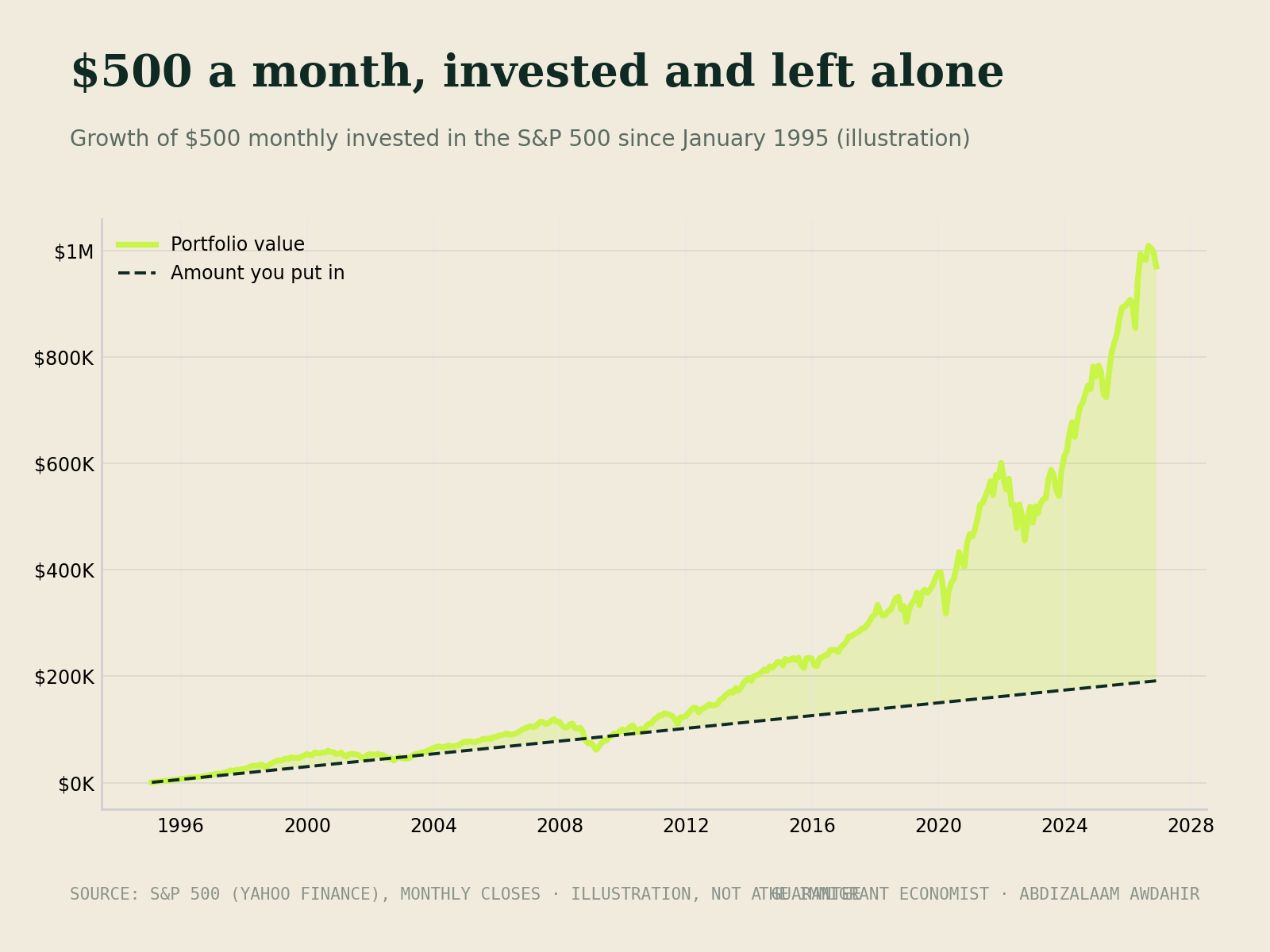
Collins shows how ordinary sums grow when they are invested and left alone. Over 1975–2015, a modest monthly contribution to the U.S. stock market grew to roughly a million dollars. That window was a good one, and the future will not repeat it exactly — but the principle holds: time does most of the work.
Source: The Simple Path to Wealth, Ch. 3. Assumes the S&P 500's ~11.9% average annual return with dividends reinvested over that specific 40-year window. Past returns do not guarantee future results.
Part two: how the market really works
The stock market scares people because it falls. Collins says: of course it does. Crashes are normal. Since 1900 the market has endured world wars, depressions, inflation and pandemics — and still trended upward, because it represents companies that keep finding ways to earn money.
The danger is not the drop. The danger is you selling during the drop. Most investors lose money not because markets fail but because fear makes them sell low and greed makes them buy high. The book's cure is to decide in advance that you will hold through the storms.
Next, Collins attacks the idea that experts can beat the market. They mostly cannot. Fees and trading costs eat their advantage, and over long periods only a tiny share outperform a plain index fund. You do not need to be smart about picking winners. You just need to own everything, cheaply.
Here is how rarely professional stock-pickers win over long periods:
Sources: Vanguard research on 1,540 active funds, 1998–2013 (18% survived and beat the index); Barras, Scaillet & Wermers, Journal of Finance 2010 (0.6% showed genuine skill); Barber & Odean on frequent traders (~1%).
The index fund: owning the whole haystack
An index fund buys every company in a market — hundreds or thousands at once — for a fee as low as a few cents per hundred dollars. Collins's favourite is a total U.S. stock market fund (such as Vanguard's VTSAX). Instead of searching for the needle, you buy the haystack.
Why does this work? Because the index automatically lets winners grow and losers shrink. It is self-cleansing. And because fees are tiny, more of the return stays with you instead of going to a salesperson.
Collins also explains bonds: loans to governments and companies that pay steady interest. They grow slower than stocks but calm the ride. Young investors building wealth can hold mostly stocks; people near or in retirement add bonds to smooth things out.
Wealth-building versus wealth-preserving
The book divides life into two stages. In the building stage you are earning and saving, and the right move is simply to buy stock index funds steadily. In the preserving stage you are living from your money, so you add bonds and cash to protect against bad years.
This is the whole portfolio. Two or three funds. No gold coins, no hot tips, no complicated products sold by someone on commission.
How fast can you become free?
The number that matters most is not your income. It is your savings rate — the share of your income you invest. Save 10% and freedom may take a whole career. Save 50% and it can come in under twenty years. Many immigrant households already live frugally; this chart shows how powerful that habit is when the savings are invested rather than sitting idle.
Source: 'The Shockingly Simple Math Behind Early Retirement,' Mr. Money Mustache (2012). Assumes 5% real investment returns and a 4% withdrawal rate; illustrative, not a promise.
Part three: the practical steps
Collins recommends using tax-advantaged accounts first. In the U.S., that means a 401(k) — especially up to the employer match, which is free money — and an IRA. In Canada, the equivalents are the RRSP, the TFSA and, for first homes, the FHSA. Inside these accounts your investments grow without yearly tax.
He also praises Vanguard because it is owned by its own funds' investors, which keeps costs low. Any provider with very cheap, broad index funds or ETFs works on the same principle.
On houses, he is a contrarian: a home is a lifestyle choice and an expense, not automatically an investment. Buy one because you want to live in it, not because someone told you renting is throwing money away. Count taxes, maintenance, insurance and the money you could have invested.
Part four: spending your money safely
How much can you take out each year in retirement without running out? Collins leans on the Trinity Study, which tested historical markets. Withdrawing about 4% a year from a balanced portfolio survived 30 years in the vast majority of cases. Withdrawing 3% survived essentially always.
So a simple rule emerges: when your investments equal about 25 times your yearly spending, you are close to financially free. Stay flexible — spend a little less in bad market years — and the plan becomes much safer.
Source: Trinity Study (Cooley, Hubbard & Walz, 1998; updated 2009), as discussed in The Simple Path to Wealth, Ch. 29. 50/50 stock-bond portfolio; the 7% row gives up annual inflation raises.
The rest of the book: life lessons
Collins closes with stories: why Social Security (and, for Canadians, CPP and OAS) is a useful floor but not a full plan; why you should avoid financial advisors who are paid by commission; why giving and enjoying money matter too. His final lesson is that money is a tool for living, not a scoreboard.
What I would adapt as a newcomer
First, build a cash emergency fund before investing aggressively. New arrivals often lack credit history, family nearby and job security; three to six months of expenses in savings protects you from having to sell investments in a crisis.
Second, budget for remittances honestly. Supporting family back home is a value, not a leak. Put it in the plan as a fixed line, then invest what remains.
Third, learn your country's accounts. A newcomer to Canada starts accumulating TFSA room only after becoming a resident; check canada.ca for your exact limits. In the U.S., ask HR about the 401(k) on day one.
Fourth, beware of affinity fraud — schemes sold by people from your own community, church or mosque, promising guaranteed high returns. Real investing is boring. If it sounds exciting and guaranteed, walk away.
Fifth, if your faith restricts interest, look for Shariah-compliant equity index funds. The core lesson — own broad businesses cheaply and patiently — still applies.
The whole book in one breath
Spend less than you earn. Avoid debt. Invest the difference in low-cost broad index funds. Hold through the crashes. Add bonds as you approach retirement. Withdraw around 4% a year. That is the simple path. It is not easy — patience never is — but it is simple, and it works for ordinary people. Including those of us who arrived with two suitcases and a work ethic.
This essay is education, not personal financial advice. Past market returns do not guarantee future results.
Evidence and further context
- JL Collins — The Simple Path to Wealth The author's original free stock series that became the book.
- Trinity Study (Cooley, Hubbard & Walz, AAII Journal, 1998) Historical test of retirement withdrawal rates.
- S&P Dow Jones Indices — SPIVA Scorecards Ongoing data on how many active funds underperform their index.
- Mr. Money Mustache — The Shockingly Simple Math Behind Early Retirement Savings rate versus years to financial independence.
- Government of Canada — TFSA and RRSP Official rules and contribution room for newcomers.
Enjoyed this? It's also on