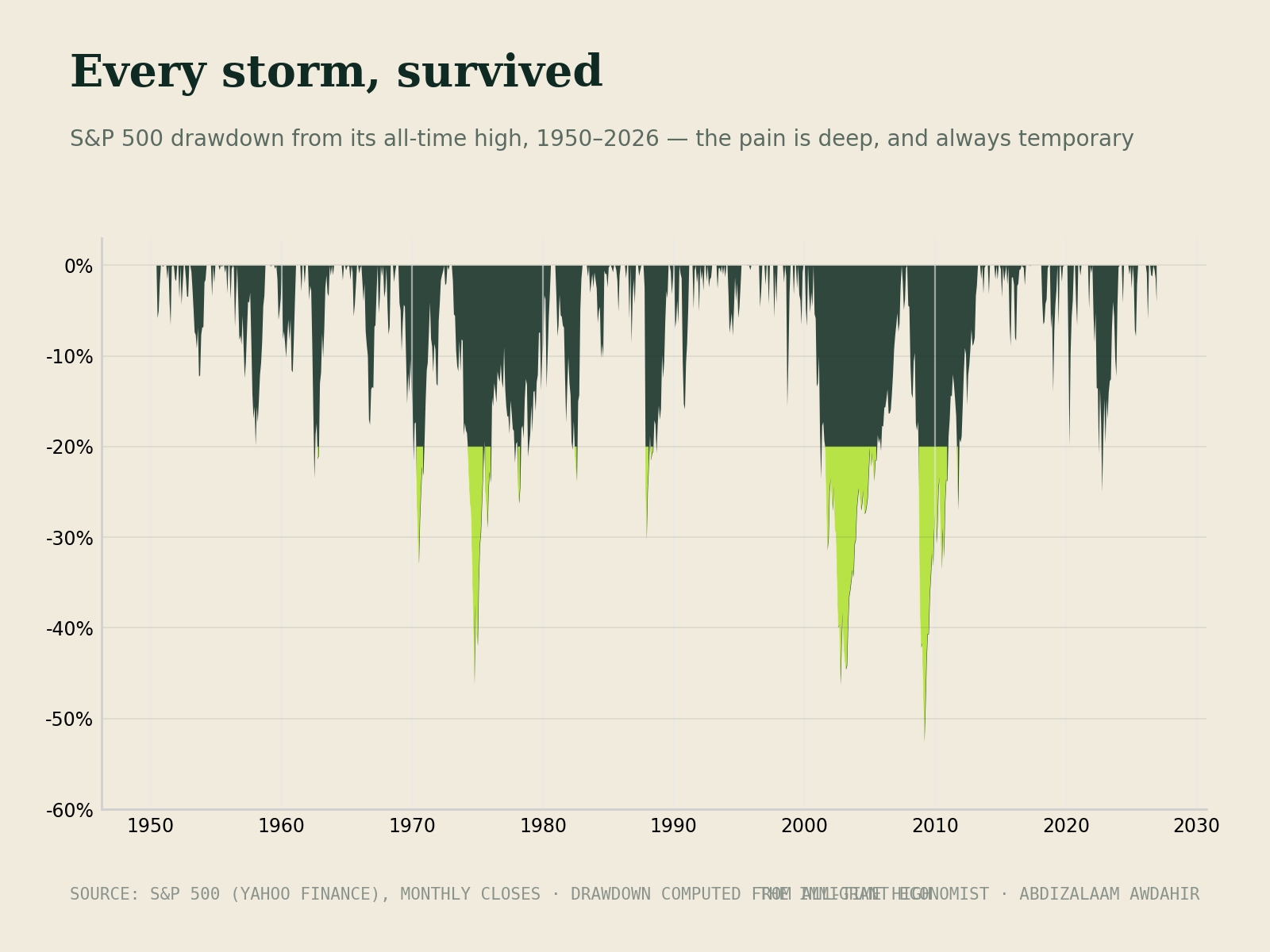
I have been listening to the audiobook of Antifragile by Nassim Nicholas Taleb, and I need to be honest with you about something: this book gave me intellectual whiplash. One chapter would have me nodding along, thinking this is one of the most important ideas I have ever encountered. The next chapter would have me wincing at the author's arrogance, his grudges, his tendency to insult entire professions by name. I kept asking myself: is this man a genius, a crank, or somehow both?
If you have read Taleb, you know exactly the feeling I am describing. And if you haven't — this essay is my attempt to give you the gold without the gravel. Because underneath the bombast, Antifragile contains an idea that I believe every newcomer to the West needs in their bones. It is the idea that explains why some families arrive with nothing and build unshakeable lives, while others arrive with advantages and crack under the first real stress. And it is an idea you already understand better than most professors — because you have lived it.
The wind that puts out the candle
Taleb opens the book with a line I have not stopped thinking about: wind extinguishes a candle and energizes fire. Same wind. Two completely different outcomes. The candle and the fire are not equally tough — they are different kinds of things. And that observation turns out to be the key to everything.
From it, Taleb builds a simple triad — three categories that everything in the world falls into. The fragile breaks under stress and shocks: a wine glass, an over-leveraged bank, a life with zero savings and one income. The robust withstands stress but doesn't improve: a rock, a government bond, a steady paycheck. And then there is the third category — the one Taleb had to invent a word for, because no language on earth had it. The antifragile gets stronger from stress. It needs shocks, volatility, and disorder the way muscles need resistance. Remove the stress and it doesn't stay the same — it weakens.
Think about your own body. Lift weights and you tear muscle fibers — small, controlled damage — and the body rebuilds them stronger than before. Avoid all physical stress and your muscles melt away. That is antifragility. Your immune system works the same way: a child raised in a sterile bubble has weak immunity, while exposure to ordinary dirt and germs builds the defenses that protect them for life. Evolution itself is antifragile — it runs on stress, error, and catastrophe, and each disaster leaves the survivors stronger.
The category nobody named
What struck me most is that we all knew this third category existed, but we never had a word for it. We say 'what doesn't kill you makes you stronger' — grandmothers have said it for centuries — but our formal thinking, our economics, our risk management, our education systems, only ever recognized two categories: things that break, and things that resist. Nobody modeled the things that improve from disorder.
And once you see the third category, you see it everywhere. A restaurant industry gets better when bad restaurants fail — the failures are information, and the survivors absorb the lessons. An economy that never allows small recessions builds up hidden weaknesses until a giant one arrives. A person who has never been allowed to fail at anything small shatters the first time they fail at something big. Taleb's word for the people who don't understand this is 'fragilistas' — well-meaning experts, planners, and overprotective parents who try to remove every shock from a system, and in doing so guarantee that when the shock finally comes, it is catastrophic.
The most antifragile people on earth
Here is where I want to speak directly to my immigrant readers, because this is the part of the book I experienced most personally. Think about what it actually takes to leave your country and start again in America or Canada or anywhere in the West. You walked away from your language, your family network, your credentials that nobody here recognizes, your whole social operating system. You landed in a place where the rules were invisible to you — no orientation, no handbook — and you figured it out anyway. You worked jobs beneath your education while studying at night. You learned a new financial system with zero guidance. You absorbed shocks that would flatten people who grew up comfortable.
By Taleb's framework, you are the fire, not the candle. Every shock made you more capable. And I want to say this without any shame attached, because too many newcomers carry quiet shame about their starting point — the accent, the gaps in local knowledge, the degree that got discounted. The antifragile frame turns that story on its head: the difficulty was not your defect. It was your training. The person who has only ever known stability is fragile in ways they cannot see. You have stress-tested yourself against reality and you are still standing. That is not a weakness in your story. That is the whole strength of it.
But — and this is the crucial turn — antifragility is not automatic. The storm only strengthens you if the stress is survivable and you are positioned to gain from it. A shock that wipes you out doesn't make you stronger; it just wipes you out. Taleb is very clear on this: the point is never to seek ruin. The point is to structure your life so that the shocks you absorb are small enough to survive and frequent enough to teach. Small failures, small losses, small experiments — each one is a vaccine dose of reality.
Where fragility hides
Now apply the triad to money and work, and some uncomfortable things become visible. The job that feels safest — one employer, one salary, a mortgage sized to the maximum the bank allowed, credit payments depending on every paycheck arriving on time — is often the most fragile structure of all. It looks robust. But it has one load-bearing wall, and if that wall cracks, everything comes down at once.
The newcomer version of this trap is familiar to many of us: you finally land the good job, and within two years the apartment is upgraded, the car is financed, and the entire household runs at full capacity with zero slack. I have written before about the arrival effect — the way a first Western paycheck feels enormous and quietly inflates your lifestyle until the 'enormous' salary is fully consumed. Through Taleb's lens, the arrival effect is fragility construction. You took a position of natural antifragility — your ability to live well on less, which you brought from home — and traded it for a structure that needs everything to go right.
The opposite looks boring from the outside: savings that can absorb a layoff, skills that transfer between industries, expenses low enough that losing one income is a problem rather than a catastrophe, a small side project that could grow. Nothing about that life is dramatic. But stress hits it and it bends, learns, and comes back stronger. That is the whole game.
The uncomfortable part: let's talk about Taleb himself
I promised you honesty, so here it is. This book is deeply polarizing, and the polarization is not a misunderstanding. Taleb is a Distinguished Professor of Risk Engineering at NYU and a former options trader who made his fortune betting on market crashes — a man with genuine skin in the game. The public rates the book highly, around four stars across tens of thousands of reviews. But critics — including academics in medicine and the social sciences — push back hard. They call the book scattered, repetitive, and arrogant. A five-hundred-page book that could have been one hundred. A reviewer in psychiatry objected strongly to his dismissive takes on mental health care. Even his admirers admit you must tolerate a lot of dogmatic bombast to reach the insight.
My own take, after sitting with it: read the book for the concepts, not for the man. The idea of antifragility is real and important — it belongs in the same conversation as evolution and complex systems. But you do not need to adopt Taleb's personality along with his philosophy. You can believe that systems need stress to grow without believing that all academics are frauds or that all modern medicine is a conspiracy. Take the framework. Leave the feuds.
And actually, there is a meta-lesson in that, which Taleb himself would appreciate: information is antifragile. A strong idea survives being separated from a flawed messenger. The discomfort this book creates — the dissonance you feel when a sentence is both brilliant and infuriating — is not a bug in your reading. It is the book working on you. If nothing you read ever makes you uncomfortable, you are not learning anything new.
What I am taking from it
So here is my personal summary, the way I have written it in my own notes. First: ask of everything in your life — my job, my savings, my expenses, my plans — which of the three categories is this? Fragile, robust, or antifragile? Just naming the category changes your decisions. Second: never let a single shock be able to end you. Survival is the floor; everything else is built on top of it. Third: stop trying to eliminate all volatility from life. You cannot do it, and the attempt makes you fragile. Instead, take small doses of difficulty on purpose — new skills, small experiments, controlled risks — and let them train you.
In the essays ahead, I will go deeper into how Taleb applies this to money — his famous barbell strategy — and I will give you a list of the twenty-five lessons from this book that changed how I think about work, investing, health, and raising children. Some of them will challenge you. Good. That is what they are for.
The wind is going to blow. It always does. The only question is whether you have built yourself as a candle or as a fire.
Sources and further reading
Nassim Nicholas Taleb, Antifragile: Things That Gain from Disorder (2012) — Book I for the triad, Book VII for the ethics. Taleb's earlier Fooled by Randomness and The Black Swan set the stage. For the critical perspective, the long-form reviews of Antifragile across Goodreads and academic blogs capture the polarized reception honestly. Seneca's Letters from a Stoic — Taleb's chapters on Stoicism and 'premeditatio malorum' sent me back to the original, which is two thousand years old and reads like it was written last week.
Enjoyed this? It's also on