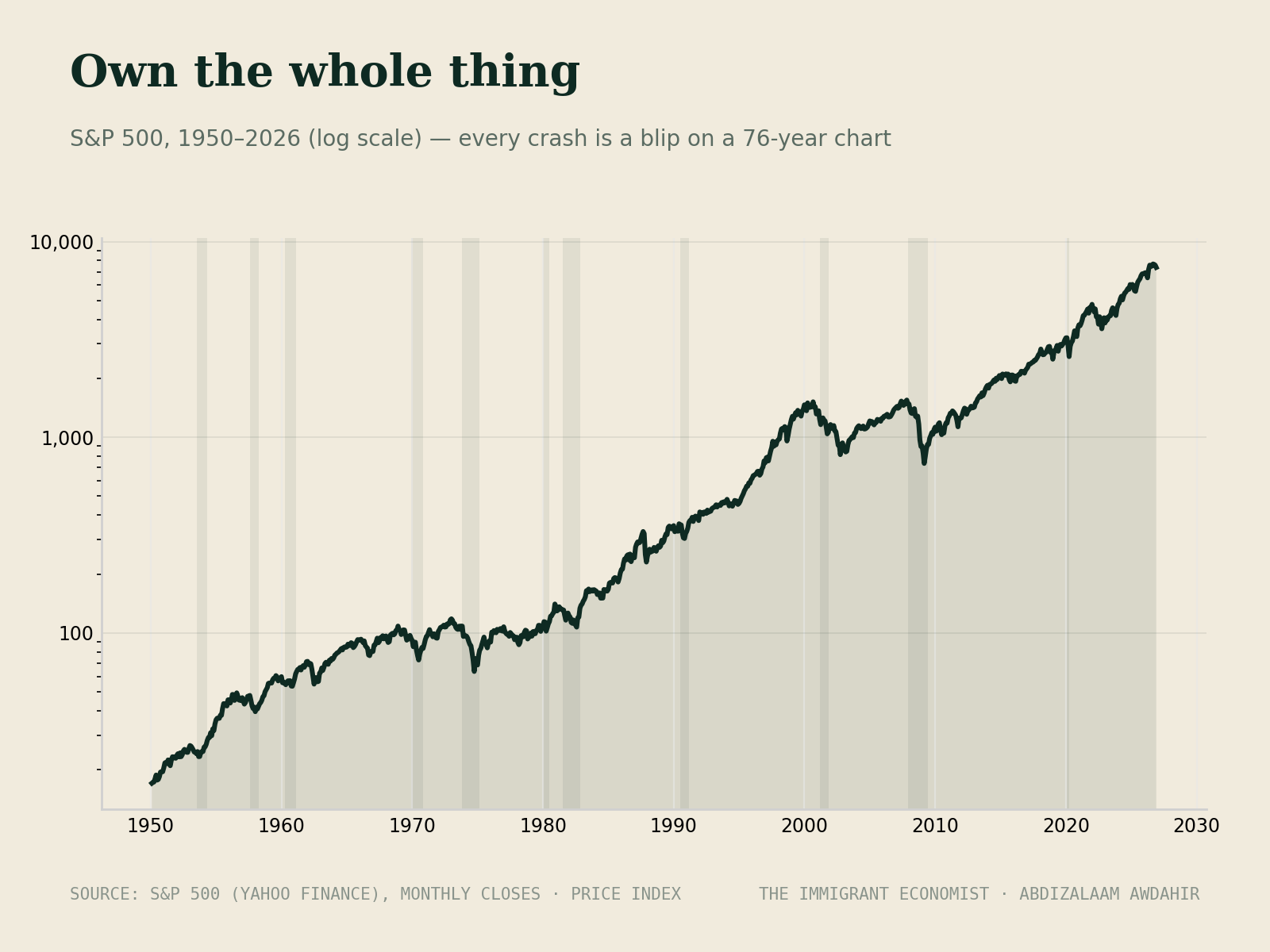
Imagine you want to bet on a horse race, but instead of picking one horse, you buy a tiny slice of every horse in the race. You won't win big — but you also can't lose everything to one lame horse, and you're guaranteed to own a piece of the winner. That's an index fund. It's a single investment that holds small pieces of hundreds or thousands of companies at once.
When people say “the market returned 10%,” they usually mean an index — a list like the S&P 500, which tracks 500 large American companies. An index fund simply buys that list. No manager picking stocks, no genius predictions. Just the whole haystack instead of a search for the needle.
Why the dull option usually wins
Here's the uncomfortable fact that the finance industry would rather you not dwell on: over long periods, the vast majority of professional stock-pickers underperform the simple index. Not some of them. Most of them. And they're full-time experts with research teams. The reason is costs and humility — every trade has a fee, every forecast has an error rate, and both compound against you.
Index funds flip this. Their fees are tiny — often a tenth of what active funds charge — and they don't pretend to know the future. Over decades, that fee difference alone can translate into six figures of extra retirement money on an ordinary salary. It turns out dull is exactly what you want from your money.
How to actually start
The mechanics are simpler than the mythology. Open an account with a reputable, low-cost brokerage — ideally inside whatever tax-advantaged retirement account your country offers. Pick a broad, low-fee halal index fund: SPUS — a Sharia-screened version of the S&P 500 — is the classic starting point, and HLAL is a strong global alternative. Both screen out companies whose business (alcohol, gambling, conventional interest-based banking) or debt levels conflict with Islamic principles, so you get the whole haystack without the haram. Set an automatic monthly purchase, even if it's small. Then — this is the hard part — leave it alone.
The market will drop 20% at some point. It will feel terrible. Every long-term investor's returns are partly payment for enduring exactly that feeling without selling. Your plan should be written down before the storm: I buy every month, I don't watch the news, I check in once a year. That's the whole strategy, and it has beaten most clever ones for a century.
Enjoyed this? It's also on