Ronald Read spent his career as a gas station attendant and janitor in Vermont. He died in 2014 with over $8 million, which he left to his local library and hospital. Richard Fuscone was a Harvard-educated Merrill Lynch executive who went bankrupt in the 2008 financial crisis, surrendering his mansion to the bank. Morgan Housel opens The Psychology of Money with these two lives for a reason: financial success is not a hard science. It's a soft skill — and behavior beats intelligence almost every time.
Of all the money books I've read, this is the one I hand to people first — especially friends who, like me, started their financial lives in countries where the rules were different. Because the book isn't really about money. It's about the stories we carry in our heads about money, and how those stories can be perfectly rational and completely wrong at the same time.
Everyone's money instincts were earned somewhere
Housel's first big idea: no one is crazy. Everyone's financial behavior is anchored to the economy they grew up in. If you came of age during high inflation, you learned that cash is trash and money must be spent fast. If you watched a bank collapse or a currency devalue, you learned that institutions cannot be trusted and savings must be hidden, movable, and close. These aren't foolish beliefs — they were survival skills, earned the hard way.
But here's the immigrant's dilemma: the instincts that protected you in an unstable economy become liabilities in a stable one. Hoarding cash 'just in case' means inflation quietly eats 3% of it every year. Refusing to invest because 'the market is a casino' means missing the single most reliable wealth-building machine ordinary people have ever had access to. The first work of building wealth in the West isn't opening an account — it's recognizing that your risk instincts were calibrated for a different country.
Volatility is a fee, not a fine
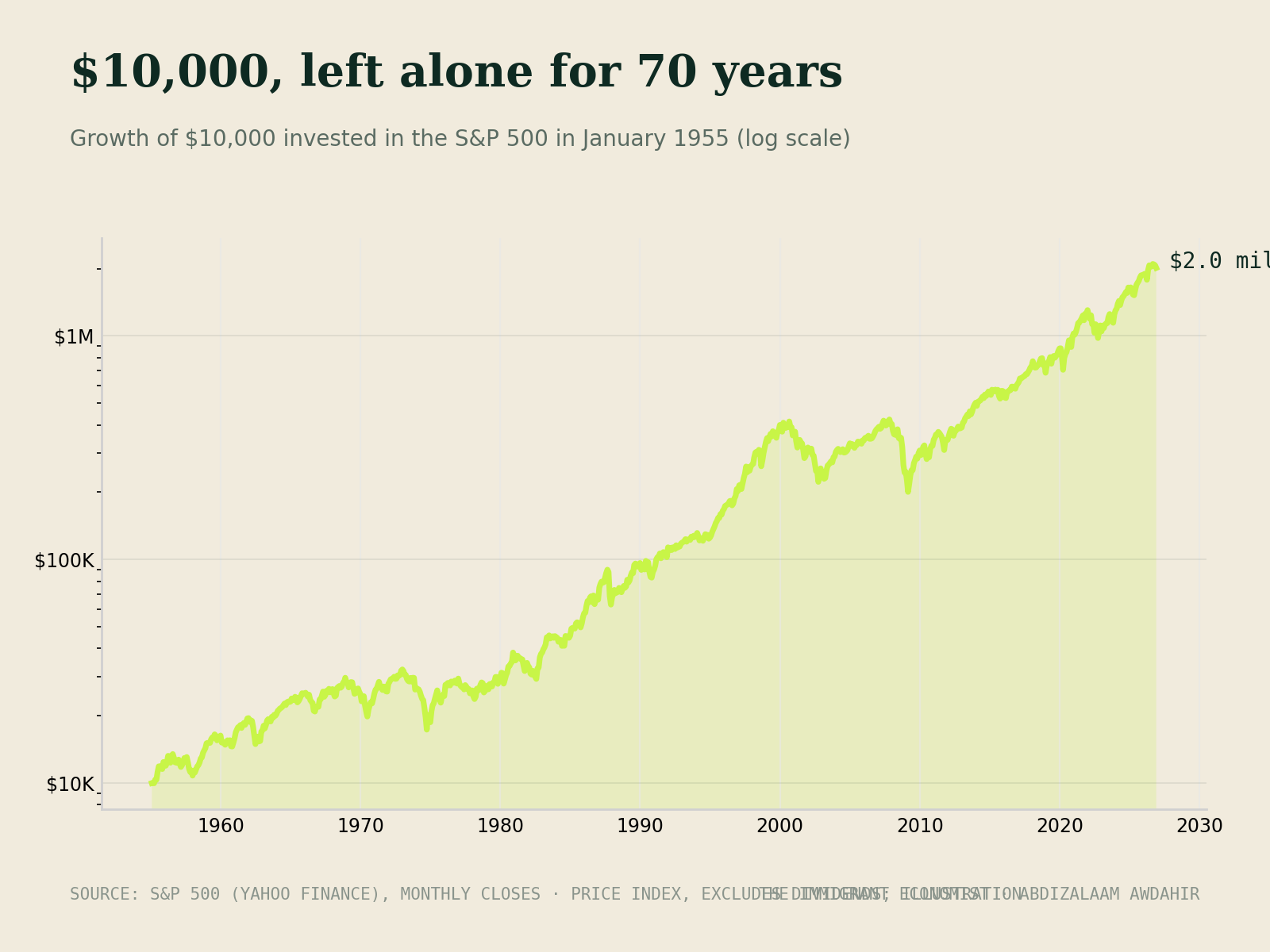
The single most valuable sentence in the book, for me: view market volatility as a fee, not a fine. A fine is a punishment for doing something wrong — it makes you want to stop. A fee is the price of admission for something worth having. The stock market's long-term returns are not free; the price is enduring regular, stomach-turning drops without selling. Investors who treat a 20% decline as a fine sell at the bottom and lock in the loss. Investors who treat it as a fee hold on and collect the return.
This reframing is everything for newcomers. When you've lived through real economic collapse, a market dip doesn't feel like a fee — it feels like the beginning of the thing you've seen before. It isn't. A diversified index fund in a stable economy recovering from a crash is a pattern with a century of evidence behind it. Your fear is understandable. It is also expensive.
Survival first, returns second
Housel's other great theme is what he calls room for error. Getting rich and staying rich are different skills: getting rich requires taking risks and being optimistic; staying rich requires humility and fear — the fear that everything you've built can be taken away. The plan that survives is the one with a margin of safety: an emergency fund, no ruinous leverage, no bet so large that a bad outcome ends the game.
Because — and this is the tail-events idea — most of what happens in markets and in life is driven by a small number of extreme events. You don't need to be right often. You need to avoid the one catastrophic loss that forces you out of the game entirely. A janitor became a millionaire not by being brilliant, but by buying good companies and never, ever being forced to sell. Survival is the strategy.
What I took from it
Three sentences I return to constantly. Freedom is the highest dividend money pays — the goal isn't stuff, it's control over your time. Save without a specific reason — the savings that save you are the ones you didn't earmark. And define 'enough' before the world defines it for you — the hardest financial skill is getting the goalpost to stop moving.
In the three-engine framework I use with readers — and expand in my upcoming book — this book is the behavioral engine: it repairs how you see risk. Next in the series: the operational engine, from a couple who saved 70% of their income and retired to the woods.
Enjoyed this? It's also on