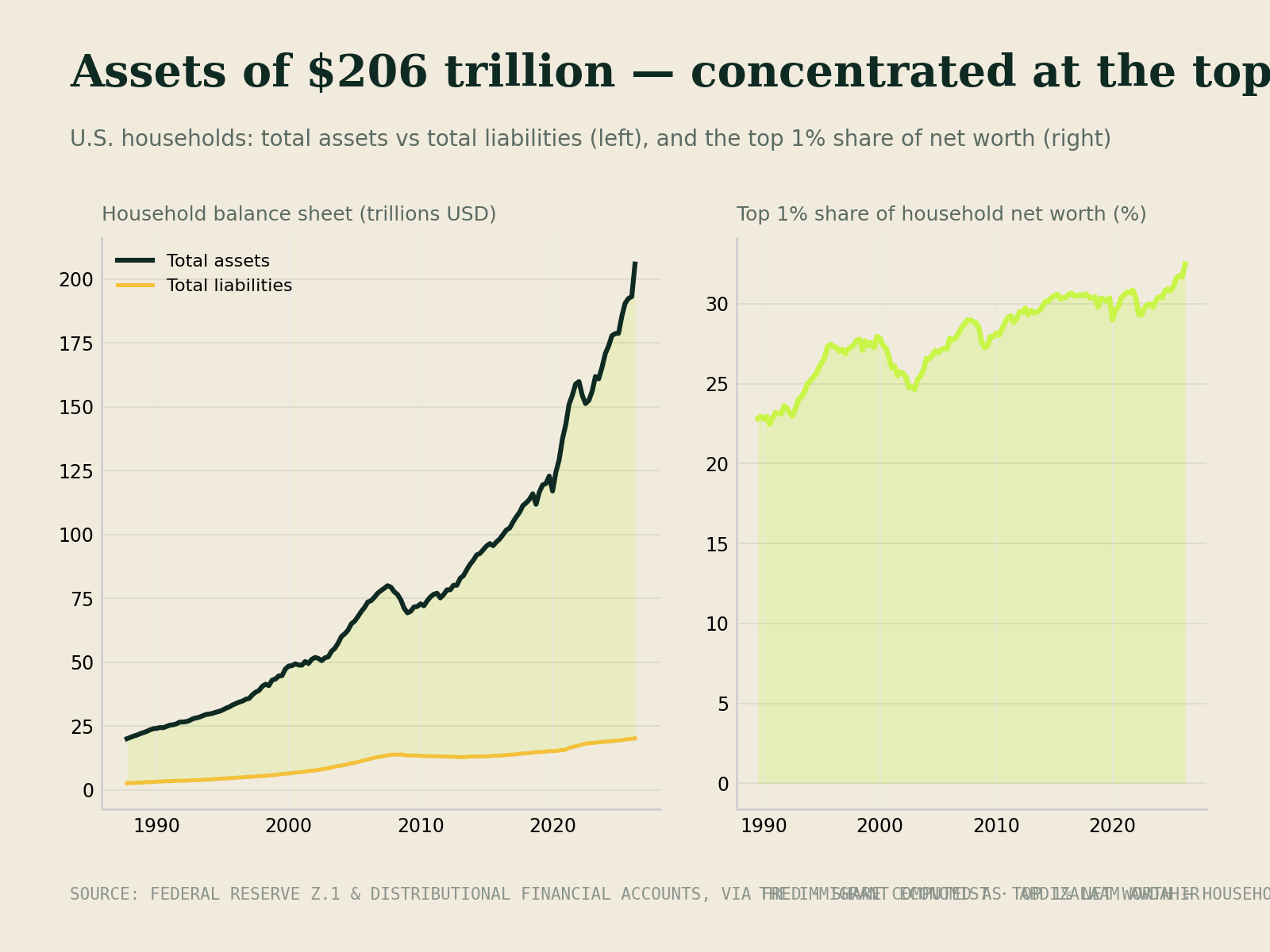
The latest Federal Reserve Financial Accounts put U.S. household assets at $205.6 trillion against $21.5 trillion of liabilities at the end of 2025. Leverage around 10% of assets is low by historical standards. When people say the consumer is strong, this is the chart they mean.
Source: Federal Reserve Z.1 Financial Accounts, via J.P. Morgan Asset Management Guide to the Markets.
Where the strength actually sits
Almost half of those assets are financial — equities, funds, private business stakes — and the top 10% of households own the large majority of them. That matters for markets: a big share of consumer spending power is tied to asset prices. When stocks rally, the wealth effect flows mostly to the households that own the stocks. When they fall, those same households tighten first at the high end.
Source: Federal Reserve Distributional Financial Accounts, recent quarters. Figures rounded.
Where the stress would land
Debt is a different story. Mortgages are two-thirds of liabilities, and most U.S. mortgages are long-term fixed, which is why higher rates have been slower to bite than many expected. The pressure shows up instead in the smaller lines — credit cards, auto loans, student debt — which are held disproportionately by younger and lower-income households. Aggregate solvency and pockets of real strain can both be true at the same time.
In Canada, the plumbing is tighter. Household debt runs near $1.75 per dollar of disposable income, and mortgages renew every few years, so rate changes pass through to families much faster. It's a big reason I watch Canadian renewal cycles more closely than U.S. headline delinquency.
Sources: Statistics Canada (Table 38-10-0235-01); Federal Reserve / BEA for the U.S. Approximate, recent years.
What I do with this
Mostly, nothing dramatic. The core stays in Sharia-screened index funds on automatic contributions — that's how an ordinary family gets onto the ownership side of this chart. At the edges, I'm watching the weaker consumer lines for signs of spreading strain, and I respect that a market whose spending power leans on asset prices can turn reflexive in both directions. Read the average, then always ask who's inside it.
Sources: Federal Reserve Z.1 and Distributional Financial Accounts; Statistics Canada. Figures rounded. Not financial advice.
A quick note, always worth repeating: this is my personal journal, not financial advice. My positions are sized to survive being wrong, and everything I invest in passes Sharia screening — your situation is yours, so please do your own homework before acting on anything here.
This note is also discussed on