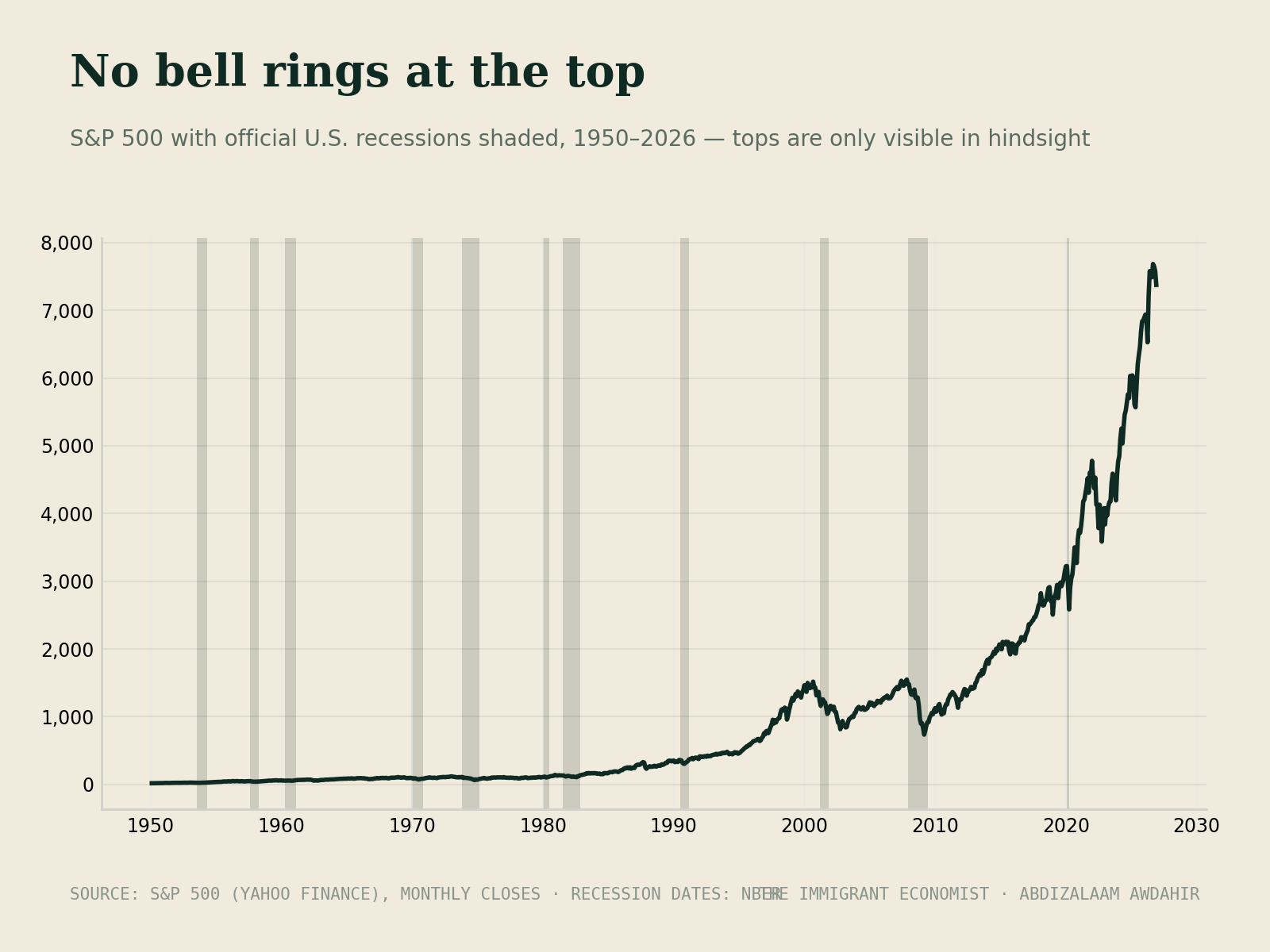
People ask me a version of the same question every few months: is this the top, is this the bottom, is the trend over? And honestly, I understand the urge behind it — we all want someone to knock on the door and tell us the weather has changed. But markets don't work that way. Nobody rings a bell. What actually happens is quieter, and a little rude: the trend stops rewarding the behavior it used to reward, and most of us keep doing the old thing anyway because it's what's been working.
So I've stopped trying to call turns. Instead I watch a short list of things that tend to change before the narrative does. I want to walk you through them the way I'd explain them to a friend over tea, because once you see them, you can't unsee them — and you'll stop needing anyone's hot take, including mine.
Breadth: who is actually carrying this thing?
The first thing I look at is breadth — how many stocks are participating in a move versus how few. An index can grind to new highs on the back of a handful of giant companies while hundreds of others quietly roll over underneath. From the outside it looks like strength. From the inside it's a crowd thinning out, one person at a time leaving the party while the music is still loud.
You don't need expensive tools to see this. Most free charting platforms will show you the percentage of stocks trading above their 200-day average, or the advance-decline line. When the index makes a new high but fewer stocks are joining it, I get careful. Not bearish — careful. There's a difference. Divergence like that isn't a signal to sell everything; it's a signal to stop adding risk and to make sure the safe end of my barbell is fully funded.
Rotation: money moves before the story does
The second thing is rotation. Markets are like rooms at a gathering — when the smart money gets uncomfortable in one room, it doesn't announce its departure. It just starts spending more time in another room. You'll notice defensive sectors quietly outperforming while the high-flyers chop sideways. Or small companies waking up after years of being ignored. Or commodities firming while everyone's still debating tech.
Rotation is how trends actually end — not with a crash, but with a transfer. The headline writers catch up months later, usually with a piece explaining the new leadership as if it appeared overnight. It didn't. If you watch where relative strength is building week over week, you saw it being built.
Credit and liquidity: the plumbing underneath
The third thing is the least glamorous and the most honest: liquidity. Stocks ultimately respond to how much money is moving through the system and how easy it is to borrow. When central banks are draining reserves and credit spreads are widening — meaning lenders are getting nervous and charging more for risk — risk assets eventually feel it, no matter how good the earnings stories are.
I keep an eye on this in plain language: are central banks adding to their balance sheets or shrinking them? Are high-yield spreads calm or creeping wider? You can find both in free public data. When the plumbing tightens, I respect it even when prices haven't reacted yet. The market can ignore plumbing for a while. It can't ignore it forever.
What I actually do with this
Here's the part people find disappointing, and I'll say it anyway: most of the time, the answer is nothing. My core money sits in halal index funds on automatic contributions, and no reading of the tape changes that. The trend-shift watching happens at the edges — it decides whether I'm adding to the small, speculative end of my barbell, trimming it, or leaving it alone entirely. It decides whether a trading idea gets real money or stays a note in my journal.
And a word I owe you plainly, because I'd want it said to me: everything I trade on the risky end is sized so it can go to zero without touching my family's foundation, and I only touch names that pass Sharia screening — no conventional banks, no interest-heavy balance sheets, nothing I couldn't defend at the dinner table. The excitement of reading markets is real. But the boring base is what lets me enjoy the excitement without fear. That's the whole game, honestly. The insights are the spice. The structure is the meal.
A quick note, always worth repeating: this is my personal journal, not financial advice. My positions are sized to survive being wrong, and everything I invest in passes Sharia screening — your situation is yours, so please do your own homework before acting on anything here.
This note is also discussed on