If you read one investing book in your life, make it The Intelligent Investor by Benjamin Graham — Warren Buffett calls it 'by far the best book on investing ever written.' And if you watch one YouTube channel, make it Common Sense Investing by Ben Felix, Chief Investment Officer and portfolio manager at PWL Capital in Canada, and co-host of the Rational Reminder podcast. Graham published his masterpiece in 1949; Felix has spent his career checking whether its lessons survived seventy-five years of data. The remarkable answer: almost all of them did.
This essay combines both into a complete Investing 101 — written for the person who has their emergency fund in place, their debts under control, and is now staring at a brokerage app wondering what on earth to do next.
Rule one: meet Mr. Market
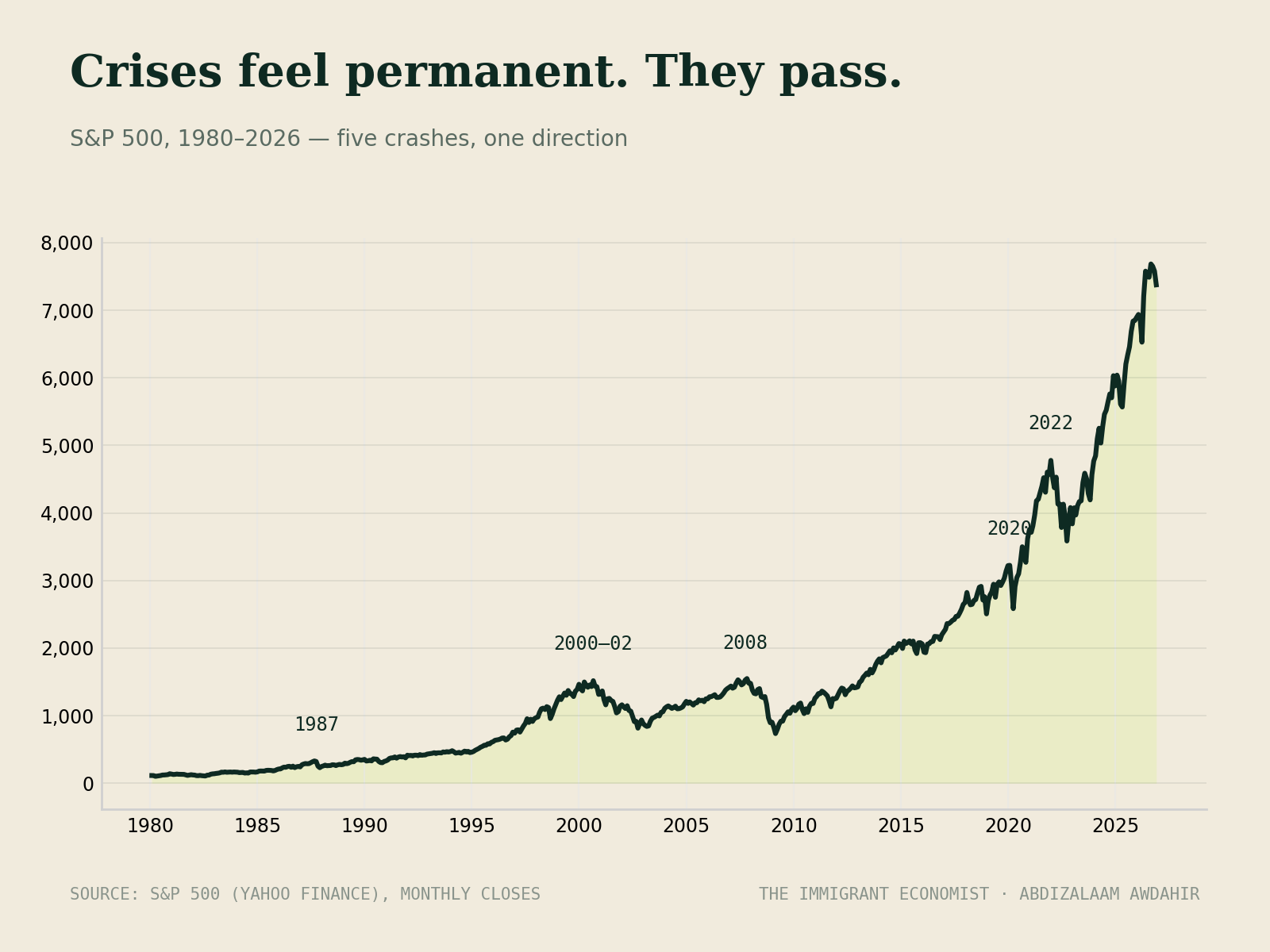
Graham's most famous invention is an allegory. Imagine you own a small share of a business, and every day your partner, Mr. Market, knocks on your door offering to buy your share or sell you his — at a different price each time. Some days he's euphoric and quotes a ridiculous high; some days he's terrified and quotes a panic low. His secret: you are free to ignore him completely. He will come back tomorrow with a new number regardless.
The stock market is Mr. Market. Prices swing on fear and greed in the short run, but in the long run they follow what businesses actually earn — Graham's line is that the market is a voting machine in the short term and a weighing machine in the long term. The investor's job is to use Mr. Market's moods, not be infected by them. For a newcomer who has lived through real economic collapse, this is the crucial reframe: a falling market is a moody partner offering you a discount, not a building on fire.
Rule two: the margin of safety
Graham's central concept, in his own words the secret of sound investment: always leave a margin of safety. Buy for less than something is worth, diversify so no single failure can ruin you, and never take a risk whose bad outcome ends your game. Forecasts will be wrong — the margin of safety is what saves you when they are.
For the ordinary investor, the modern translation is simple: don't bet everything on one stock, one sector, or one country. Own hundreds of companies across the world through low-cost halal index funds — SPUS and HLAL hold the market while screening out businesses that fail Islamic compliance — keep your emergency fund separate so you're never forced to sell in a crash, and let time do the compounding. Graham called the person who does this the 'defensive investor' — and said their results, achieved with 'a minimum of effort and capability,' would shame most professionals.
Rule three: the evidence — stock picking and market timing don't work
This is where Ben Felix's work becomes devastating. Decade after decade, the data says the same thing: the vast majority of professional fund managers — full-time experts with research teams — fail to beat a simple low-cost index fund over long periods. The S&P's SPIVA scorecards track this across every major market, and the longer the window, the worse the professionals look. Fees are a big reason: a fund charging 2% annually must beat the market by 2% just to tie it, and compounding turns that handicap into a fortune over a working life.
Felix's research summaries make the same point about timing: missing just a handful of the market's best days — which cluster right after its worst days, when fear is highest — destroys long-term returns. His conclusion, backed by a century of evidence: you cannot beat the market reliably, and you don't need to. Own the whole market at the lowest possible cost, keep contributing automatically, and spend your energy on your career and family instead of on forecasts.
Rule four: what to actually buy
Graham suggested the defensive investor split between stocks and high-quality bonds and rebalance occasionally. For the Muslim investor, the halal counterpart of that bond portion is sukuk — asset-backed certificates that pay profit from real assets rather than interest — now available through ordinary sukuk funds and ETFs, so the defensive mix stays fully Sharia-compliant. Felix's modern version: a globally diversified portfolio of low-cost index ETFs — thousands of companies across the US, Canada, developed and emerging markets — held inside tax-sheltered accounts (TFSA/RRSP in Canada, 401(k)/IRA in the US). His model portfolios add small tilts toward factors that academic research — the Fama-French five-factor model — has shown to raise long-run returns: smaller companies, value stocks, and profitable firms. The tilts are optional refinement; the diversification and low cost are the non-negotiables.
Two of his practical lessons deserve special mention for newcomers. First, his famous '5% Rule' video on renting versus buying: a home is not automatically the best investment — run the numbers before assuming otherwise. Second, behavior beats strategy: the best portfolio is the one you can hold through a 30% crash without selling. Choose boring enough to sleep with.
The immigrant's starting checklist
Putting it all together: build your emergency fund first (Graham's margin of safety, in cash form). Grab any employer retirement match — an instant, guaranteed return. Open your tax-sheltered account. Set an automatic contribution into one globally diversified, low-cost index ETF. Then ignore Mr. Market's daily moods, review once a year, and let the weighing machine work.
That's it. The most honest conclusion in all of investing is that the optimal strategy fits in a paragraph — Graham intuited it in 1949, and Felix's evidence has been confirming it ever since. The industry profits from making it look complicated; the wealth comes from keeping it simple. This framework — mindset, savings rate, and now evidence-based investing — is the backbone of the book I'm writing for newcomers. The best free education in finance already exists; this essay is your map to it.
Sources and further reading
Benjamin Graham, The Intelligent Investor (revised edition with Jason Zweig's commentary, 2003) — chapters 8 (Mr. Market) and 20 (margin of safety) are the essentials. Ben Felix, Common Sense Investing on YouTube and the Rational Reminder podcast — start with 'Investing 101,' 'The 5% Rule,' and 'Five Factor Investing with ETFs.' Eugene Fama & Kenneth French — the academic research behind factor investing. S&P Dow Jones Indices, SPIVA Scorecards — the running score of active managers versus index funds. John Bogle, The Little Book of Common Sense Investing — the index fund case from the man who invented it. For halal implementation: the SPUS and HLAL fund pages from their providers, sukuk fund prospectuses, and the AAOIFI Sharia screening standards that define what counts as compliant.
Enjoyed this? It's also on