Every money guide starts in the same place: track your spending, open this account, buy that fund. This one starts earlier, in a place the guides never go — the wiring in your head. Because I have learned, from my own life and from hundreds of conversations with newcomers, that the biggest obstacles to building wealth in a new country are not financial. They are psychological. Three of them, to be exact: a scarcity instinct that once kept you safe, a guilt about wealth that your community may have taught you, and a set of family obligations that no Western budget template has a line for.
None of these are flaws. All three were intelligent responses to real conditions. But instincts calibrated for one economy can quietly sabotage you in another — and the first step to updating them is seeing them clearly, without shame. That is what this essay is for. No judgment lives here. You survived things most financial writers cannot imagine. We are not fixing you; we are upgrading a system that was built for a different world.
Scarcity: the instinct that protected you
If you grew up where inflation ate savings, where banks failed, where tomorrow was genuinely uncertain, you learned rules that kept your family alive: spend money before it loses value, keep assets physical and close, trust people not institutions, grab opportunities immediately because they vanish, never let a good thing sit. These are not superstitions. They are rational lessons from a hard school.
Now watch what those same rules do in a stable, low-inflation economy. 'Spend before it loses value' becomes an inability to hold savings — money burns until it is gone. 'Trust people, not institutions' becomes cash hidden from insured banks and fear of the stock market — which quietly guarantees the inflation loss you feared. 'Grab it now' becomes vulnerability to urgency — and urgency, I will tell you plainly, is the number one tool of every scammer who targets our communities. The instinct says act fast; the scammer's whole script is built to trigger exactly that.
The update is not to delete the instinct — it is to aim it. Scarcity thinking's true core is respect for money, and that respect is gold here. What changes is the strategy it serves: in a stable system, holding productive assets is safer than holding cash; institutions with deposit insurance are safer than the mattress; and the opportunities worth taking are patient ones. Keep the discipline. Retire the fear.
The guilt around wealth
Now a quieter obstacle, one we rarely say aloud. In many of our cultures, visible wealth carries suspicion — the assumption that money must have come from somewhere dirty, the proverb about the rich man and the eye of the needle, the aunties who whisper. Some of us were raised to see wanting wealth as a character flaw. And so we sabotage: we undercharge, we turn down the raise conversation, we give away the surplus, we stay small — because being seen as wealthy feels socially dangerous in a way people who grew up here will never understand.
Here is what I have come to believe, and I say it with love: money is a tool, and tools take the character of their user. Wealth in the hands of a person who sends remittances, funds cousins' educations, and carries their community is not greed — it is capacity multiplied. Every dollar you keep and grow is a dollar of future help you can give. The broke version of you can be generous with sympathy. The wealthy version of you can be generous with school fees, with seed money, with a safety net for the whole family. Wanting that is not a flaw. It is one of the most honorable ambitions a person from our background can hold. You are allowed to build. You are allowed to want to build.
The village tax
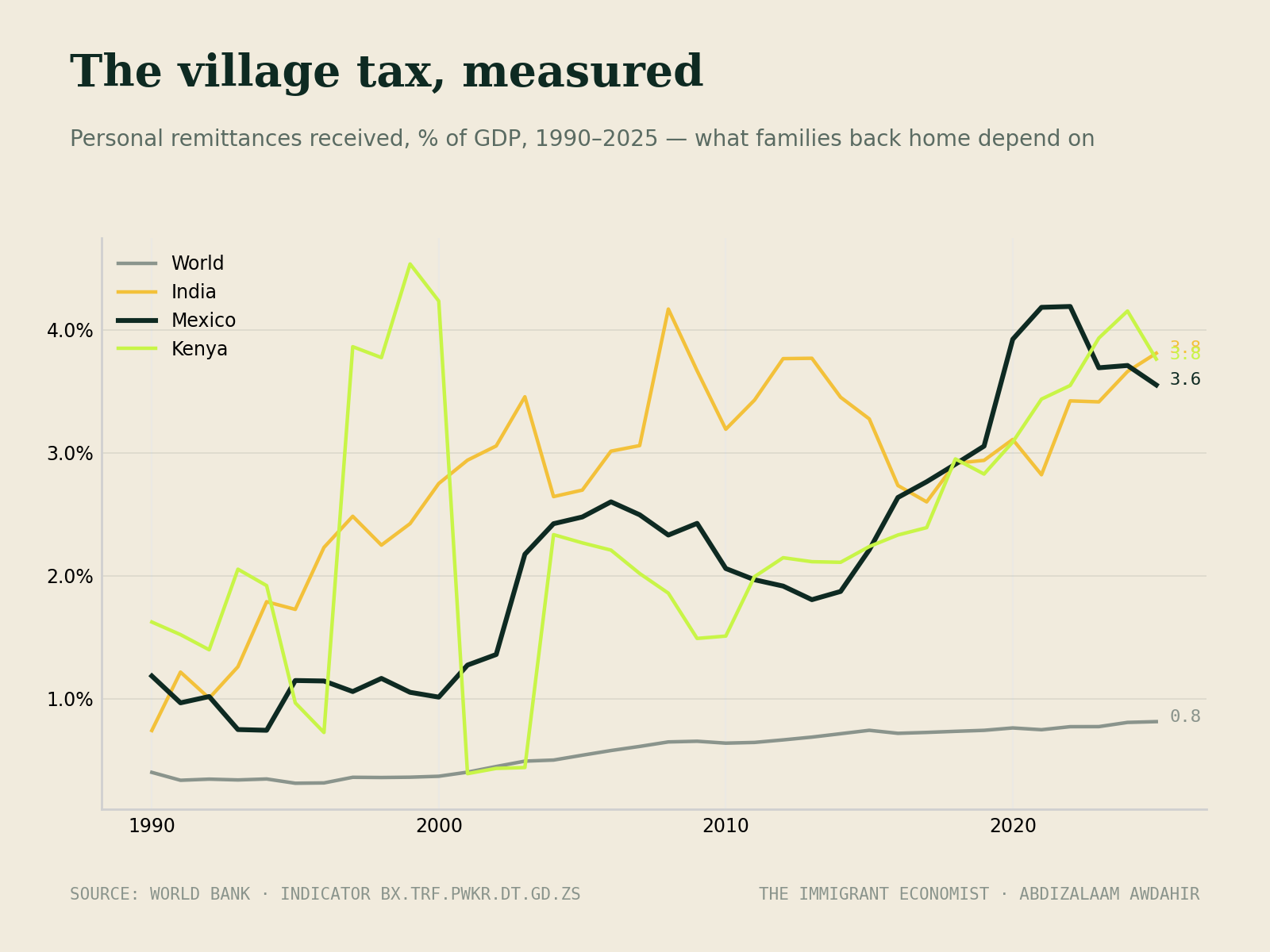
And now the one that makes Western finance advice useless to us if unaddressed: family obligation. The West has a phrase, 'black tax' or, as I call it, the village tax — the ongoing flow of money from the one who made it abroad back to parents, siblings, cousins, funerals, school fees, medical emergencies. Mainstream budgets pretend this line does not exist. Ours cannot. For many of us it is fifteen, twenty, thirty percent of income — a second rent, paid in love.
The trap is not the giving. The trap is that the giving is unstructured — reactive, guilt-driven, unlimited. Every urgent call gets a yes, the amounts are random, and your own emergency fund never forms because the family's emergencies always come first. I have watched it hollow out good earners for decades. So here is the structure that saves both you and them: the village tax gets a line in your budget — a fixed monthly number, chosen calmly in advance, treated as seriously as rent. Inside the number, give with joy and zero guilt. Beyond it, the answer is a respectful no, or 'next month's line,' because the boundary is what makes the giving sustainable for thirty years instead of three.
Two more upgrades. Where possible, convert gifts into capacity — fund the exam, the tools, the small business, not only the consumption — so the family's own engine grows and the calls slowly decrease. And have the honest conversation early: 'I can send this much, every month, reliably.' Predictable help is worth more to them than heroic rescues, and it protects the one asset the whole family depends on: your stability here.
From surviving to building
Put the three updates together and something shifts. Scarcity becomes discipline. Guilt becomes permission. The village tax becomes a budgeted act of love instead of an open wound in your finances. You stop running a survival strategy in a building season — because that is what moving to the West is: the season where the point is no longer to endure, but to construct.
I write this site for the person who crossed a border with more courage than cash. The instincts that got you here are strong ones — they just need new instructions. That is the work of every essay here, and the heart of the book I am writing. Read the rest of the foundations — the infrastructure course, the survival budget, the investing path — and you will have both halves: the mindset and the machinery. You survived the hard part. Now build.
Enjoyed this? It's also on