When you arrive in Canada or the United States, you receive no manual. Nobody sits you down and explains that a nine-digit number will follow you for life, that an invisible score will decide your rent and your car loan, that the tax system expects you to report yourself every April, or that the government owes you money you may never claim. People who grew up here absorbed all of this by osmosis — from parents, teachers, and first jobs. You are expected to just know it. This essay is the orientation that should exist: the five systems, in plain language, with the newcomer traps marked.
One note before we start: specific dollar limits and program rules change over time and differ by province and state, so treat this as the map, not the last detail — official government websites are always the final word. What does not change is how the systems think. Learn the thinking, and the details are easy to look up for the rest of your life.
Your identity number: SIN and SSN
In Canada it is the Social Insurance Number; in the US, the Social Security Number. Nine digits that become your financial fingerprint — employers need it to pay you, banks ask for it, the tax agency tracks you by it, and in the US your entire credit history hangs from it. Get yours in your first days: in Canada through Service Canada, in the US through the Social Security Administration, free, with your immigration documents.
Now the warning, and it matters: these numbers are gold to identity thieves. With your number and basic details, a criminal can open credit in your name and leave you with the damage. Guard it like your passport. Memorize it, don't carry the card. Legitimate callers almost never ask for the whole number — and no government agency will ever call demanding it, or payment, by phone; that call is always a scam. If you suspect exposure, both countries let you place fraud alerts or freezes with the credit bureaus, free. Protect the number, and you protect everything built on it.
The credit score: your financial reputation
This is the system that surprises newcomers most. In North America, your financial trustworthiness is reduced to a number — roughly 300 to 850 in the US, 300 to 900 in Canada — calculated by private bureaus (Equifax, Experian, TransUnion) from your borrowing behavior. Landlords check it before renting to you. Lenders set your interest rate by it. Some employers and insurers peek at versions of it. And here is the trap: you arrive with no score at all — not a bad score, a blank one — which to the system looks almost as risky. Twenty years of perfect financial behavior back home does not transfer. You start invisible.
The good news: a score is buildable, and faster than people think, because the recipe is public and boring. Get a credit product designed for beginners — a secured credit card, where your own deposit backs the limit, or a newcomer card from a major bank. Use it lightly — small purchases, well under the limit — and pay the full balance every month, on time, without exception. Payment history and how much of your limit you use drive most of the score. Keep old accounts open, since history length helps. Avoid a pile of applications at once, since each one leaves a mark. Do only this, and in a year or two you will have a score that opens doors — apartments, car loans at civilized rates, eventually a mortgage. You are not chasing a high score for vanity; you are building the reputation that makes everything else cheaper.
Banking: boring on purpose
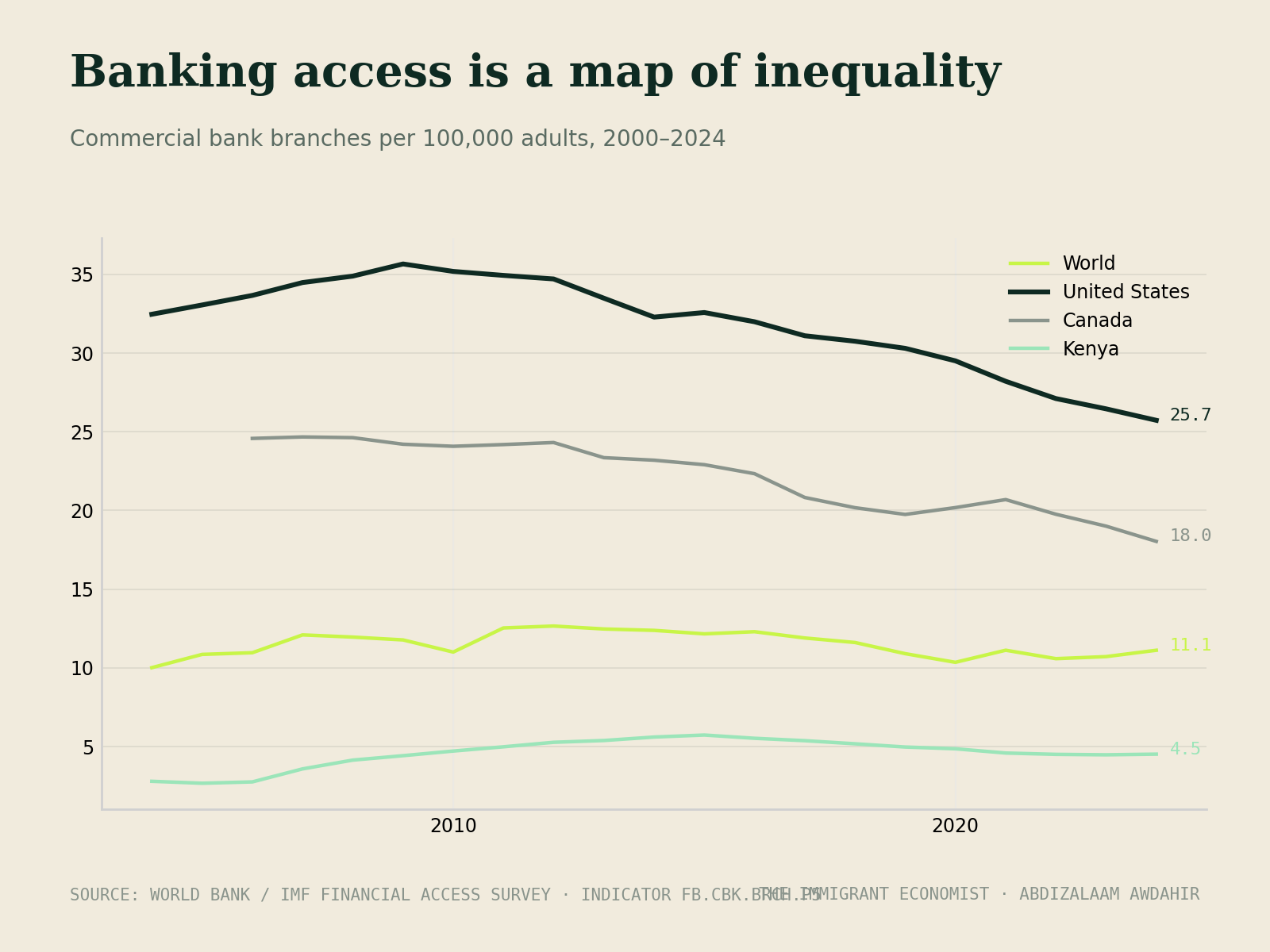
Two accounts form the base: a checking account for money moving in and out, and a savings account for your emergency fund and short-term goals — ideally one that grows your money without riba, such as an Islamic bank's profit-sharing savings account or a halal high-yield option. Both countries offer newcomer packages at the major banks with fee waivers for the first year or more; ask for them explicitly, because nobody volunteers them. Compare monthly fees and minimum balance requirements, and remember you are not married to a bank — switching is normal here.
A few things worth knowing early. Deposit insurance protects you: bank deposits are government-backed up to set limits — through the FDIC in the US and CDIC in Canada — which means an insured bank failing does not take your savings with it; check that your institution is covered. Overdraft fees are a tax on the stretched — decline overdraft coverage or keep a buffer so an unlucky Tuesday doesn't cost thirty-five dollars. And e-transfers and direct deposit are the plumbing of daily life; set up payroll direct deposit in your first week of any job, because payday automation is where every good money system begins.
Taxes: the system you report yourself to
Here is a cultural shock for many of us: in the US and Canada, the government does not simply send you a bill. You file a tax return every spring — reporting your own income, claiming your own deductions — and the system runs on honesty backed by audits. Employers withhold tax from each paycheck, and the annual return settles the difference: most employees with simple situations actually get refunds, because too much was withheld.
File every year, even if your income was low or zero — because filing is what makes you eligible for the benefits in the next section, and because a clean filing history matters for your financial record. Help exists and much of it is free: community tax clinics serve newcomers and modest incomes in both countries, and simple situations can be filed with free or low-cost software. Keep your documents — slips, receipts, records of what you send home are not needed, but income and deductible expenses are. And mark this in your brain forever: no tax agency demands payment by gift card, crypto, or wire transfer, or threatens arrest by phone. Ever. That call is a scam, and it targets our communities precisely because the system is unfamiliar.
Benefits: the money you are owed
This is the section that pays you for reading. Both countries run benefit programs that put money into the accounts of eligible residents — and newcomers routinely leave thousands unclaimed because nobody told them. In Canada: the GST/HST credit, the Canada Child Benefit — a substantial monthly, tax-free payment per child for eligible families — provincial benefits, and the RESP grant where the government adds money to your child's education savings. In the US: the Earned Income Tax Credit and Child Tax Credit for working families, subsidized health coverage through the marketplace, and education savings through 529 plans.
The mechanics matter: most benefits are triggered by filing your tax return — which is why filing every year is non-negotiable even with low income. Eligibility depends on your immigration status and residency, so verify your specific situation on the official government pages or with a community settlement agency — these agencies exist in every major city, staffed by people whose entire job is helping newcomers navigate exactly this, usually free. Use them without embarrassment. These programs are not charity; they are part of the social contract you pay into with every paycheck. Claiming what the law provides you is not taking advantage. It is participation.
The manual is short
Step back and the whole infrastructure compresses to a paragraph. Guard your identity number. Build your credit score with one boring card paid in full. Bank simply, with insured institutions and automated payday deposits. File your taxes every year, honestly, with free help if you need it. Claim every benefit you are owed. None of this requires wealth, connections, or perfect English — it requires knowing the systems exist, which is the one thing nobody bothered to tell us. Now you know. Teach the next family.
Enjoyed this? It's also on