There is a phrase you will hear in North America — 'generational wealth' — and if you are an immigrant, it can sting a little. Because generational wealth is exactly what most of us did not receive. Nobody handed us a paid-off house, a college fund started when we were born, or a grandfather's brokerage account. Many of us are the first generation in our families to even have a retirement account. We are not continuing a relay race; we are the first runner.
But here is the reframe I want you to carry through this whole essay: starting from zero is still starting. Every wealthy family in this country has a first generation — someone who arrived, or was born, with nothing and built the base everyone else stands on. That person can be you. And because you are building deliberately, with open eyes, you can skip mistakes that took other families three generations to learn. Let me walk you through the four pillars: housing, the children's education, protecting it all with estate planning, and the question nobody else writes about — helping family back home without destroying what you are building.
Pillar one: housing, honestly
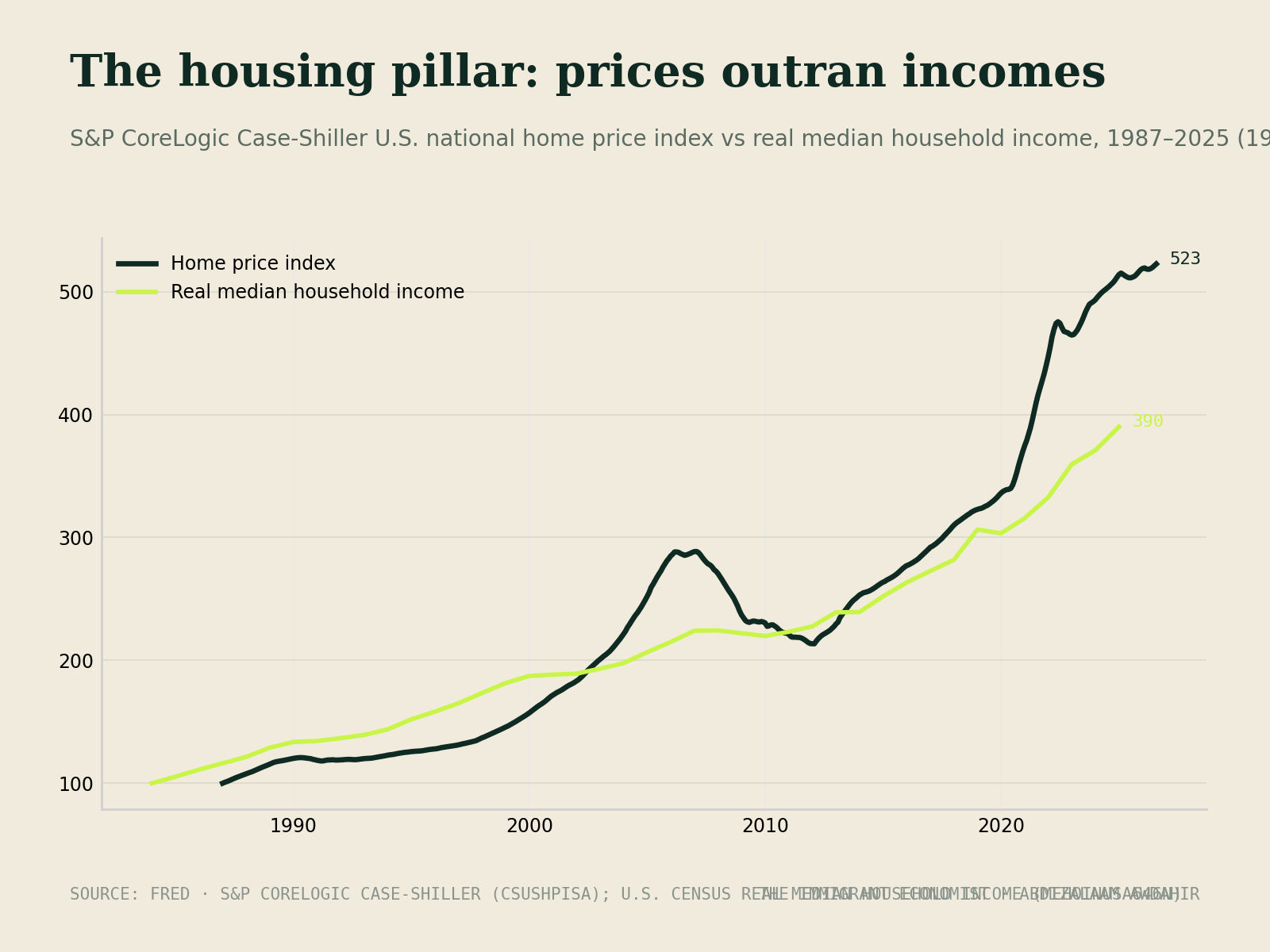
In most immigrant families, real estate is the dream. It is the asset you can see and touch, the asset that survived back home, the asset that says 'we belong here now.' I understand that pull deeply. But I want you to hold two truths at once. First truth: for most ordinary families, a home is the largest and most successful forced-savings plan they will ever have — every mortgage payment converts income into equity, and over decades that equity becomes the family's foundation. Second truth: a home is not automatically a good investment at any price, and buying too much house too early is one of the most common ways newcomer families become fragile.
So the rules I teach: buy when you are staying — when your immigration status, job, and city are stable enough that five or more years in one place is likely. Buy beneath what the bank approves you for, because the bank's job is to maximize its loan, not your safety; a housing cost that leaves nothing for investing and emergencies is a golden cage. And remember that your halal index funds are also building wealth while you save for the down payment — renting for a few years while you invest is not failure, it is sequencing. The home is a pillar, not the whole building. Families who put every dollar into the house and nothing into investments often end up house-rich and cash-poor, which is a stressful kind of wealth.
Pillar two: the children's education
Ask immigrant parents what all the sacrifice is for, and most will say the same word: the kids. Education is our inheritance plan. And both countries hand you a remarkable tool for it — which most newcomers never hear about until it's too late. In Canada it is the RESP: a registered education savings account where the government adds a grant — free money, a percentage match on your contributions up to an annual limit — and the growth is tax-sheltered until the child studies. In the US it is the 529 plan: contributions grow tax-free and come out tax-free when used for education. The exact limits and grant percentages change over time, so check the official government pages, but the principle is permanent: these accounts are among the only places the government literally adds money to yours.
Two pieces of hard-won advice here. First, start small but start — even a modest monthly amount opened when the child is young has eighteen years to compound, and in Canada the grant money alone makes it one of the best returns available anywhere. Second, and I say this with love: do not fund your child's education by emptying your own retirement. Your child can borrow for tuition if they must; nobody can borrow for retirement. A parent who is financially secure at seventy is a greater gift to their children than a fully funded degree followed by a parent who must be supported. Put your own oxygen mask on first — that is not selfishness, it is strategy.
Pillar three: the paperwork of love
Nobody likes this part, so I will be brief and blunt. If you died tomorrow, who gets what you have built? Without a will, the answer is: the government's default formula, decided slowly and expensively through courts, possibly split in ways you would never have chosen — and in the worst case, your children waiting in legal limbo while accounts freeze. Estate planning sounds like something for the rich. It is actually most urgent for families with the least margin for error, and for immigrants it carries an extra trap: assets and family members spread across two countries, under two legal systems that do not coordinate.
The checklist is short and boring and essential. A will, updated when your family or assets change. Beneficiary designations on every account — your retirement accounts and life insurance pass by the named beneficiary, not by the will, so an outdated form can override your intentions entirely. Life insurance if anyone depends on your income — term insurance is cheap and honest; the expensive investment-linked policies are usually the industry's favorite, not yours. Powers of attorney, so someone you trust can act if you are incapacitated. And a simple document listing your accounts, assets, and contacts, in both countries if that is your reality. One weekend of paperwork. Decades of protection. This is the most loving boring task you will ever do.
Pillar four: the family back home
Now the question that is invisible in mainstream finance advice and unavoidable in our lives: what do we owe the people we left? Remittances and family support are real, honorable, and — if unstructured — capable of quietly consuming the entire engine of your wealth-building. I have watched nurses and engineers in Toronto and Houston who earn more than their parents ever dreamed of, yet own nothing at fifty, because the outflow never had a boundary.
The solution is not coldness; it is structure. Give family support a line in your budget — a fixed number, chosen in advance, treated as non-negotiable as rent. When the number is fixed, saying yes inside it is easy and saying no beyond it stops being a personal rejection and becomes a plan. Where possible, shift from funding consumption to funding capability: school fees, a small business, a repair that raises the family's own earning power. Teach the system you have learned here. And have the honest conversation, early, that the money is not unlimited — that you are building something meant to help the family for decades, not just this month. A structured giver helps for thirty years. An unstructured giver burns out or goes broke in ten. Choose the thirty.
The long view
Generational wealth is not a number. It is a stack: some assets, some education, some protection, some knowledge passed down. Your children will grow up watching a parent who reads statements, asks about fees, invests every month, and talks about money without fear. That modeling alone is an inheritance most families never get. The accounts compound; the habits compound faster.
So do not let anyone make you feel behind. The family with the paid-off house and the grandfather's account started somewhere too — with a first runner. You are running the hardest leg, the uphill one, the one with no map. Every pillar you put in place — the home bought wisely, the education account opened early, the will signed, the remittances structured — is a step your children will never have to take from zero. That is what it means to be the ancestor. Start where you are. The generation after you will stand on it.
Enjoyed this? It's also on