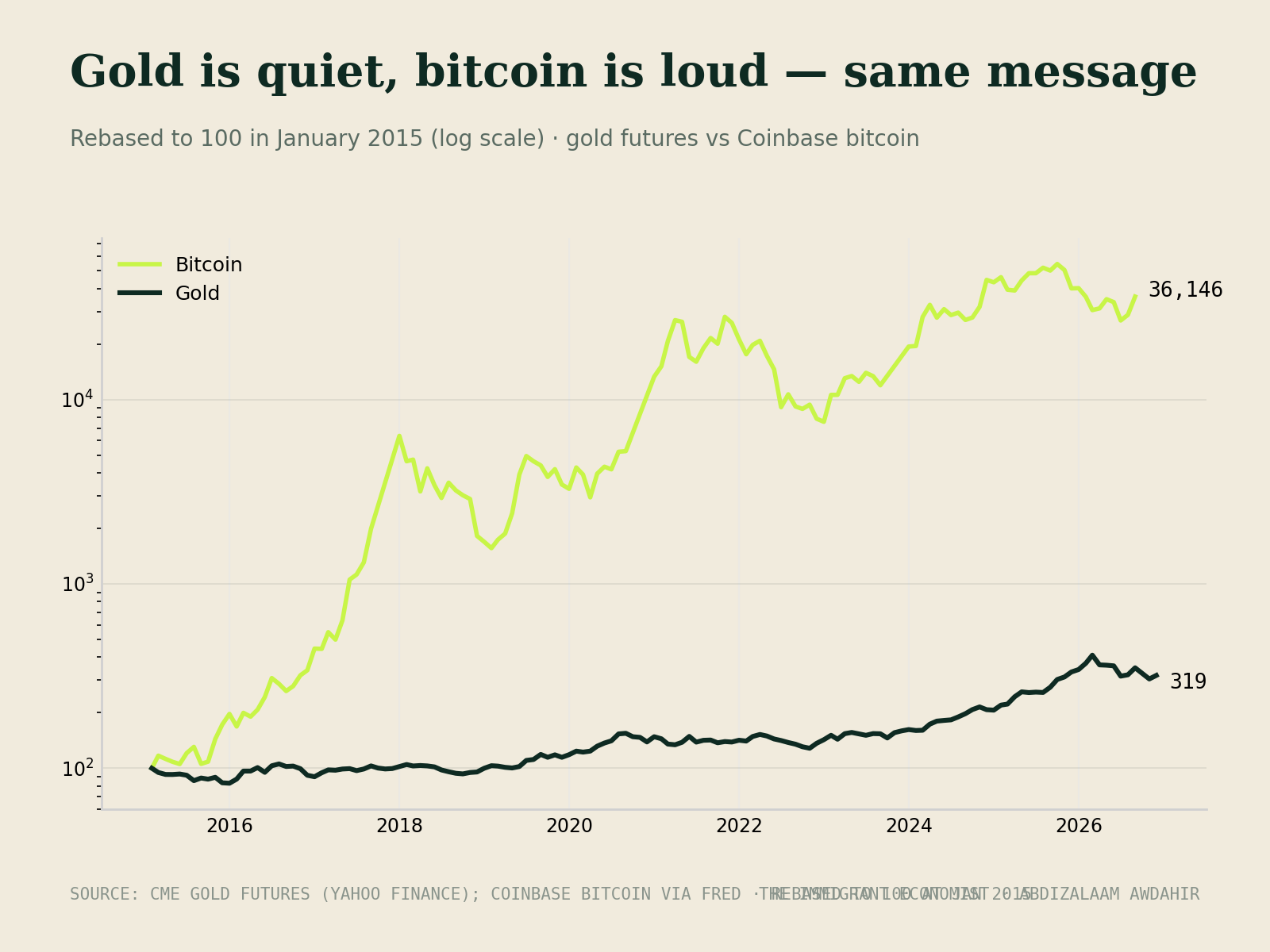
There's a pattern in markets I find genuinely fascinating, and it's been showing up again lately: gold and Bitcoin — the oldest hard asset and the newest — drifting in the same direction at the same time. One is hoarded by central banks and grandmothers. The other is held by twenty-five-year-olds with strong opinions about monetary policy. They are not the same crowd. When both crowds start buying, I don't ask which asset is right. I ask what both crowds are worried about.
The answer, I think, is the same thing it has always been: trust in paper. I wrote a long essay on this site about the five-thousand-year history of money — from clay tablets to fiat — and the short version is that every currency system eventually faces the same temptation: print a little more, stretch the unit, let tomorrow's debts be paid in cheaper money. Hard assets are the market's hedge against that temptation. When they get a bid, the market isn't being irrational. It's reading history.
What the gold bid actually means
Gold doesn't pay you anything. No dividend, no profit share, no rent. Its entire case is that nobody can print it, and five thousand years of human agreement stand behind it. So when central banks themselves — the very institutions doing the printing — become the biggest buyers of gold, that's not a trade. That's a confession. They're telling you, in their own actions, that they'd rather hold the metal than hold more of each other's paper.
For an ordinary family, I read that as context, not a command. Gold belongs in a portfolio the way insurance belongs in a house — a measured slice that does its best work exactly when everything else is having its worst. I like it small and boring: a few percent, held patiently, rebalanced occasionally. The people who get hurt with gold are the ones who fall in love with it after it has already run, and buy it as a lottery ticket instead of as insurance.
And Bitcoin — said carefully
Bitcoin is the louder, younger, more volatile member of the family, and I hold my opinions about it with open hands. What I will say is this: the thesis underneath it — a scarce asset no government can inflate — is the same thesis as gold, written in code instead of geology. The difference is age and temperament. Gold has fifty centuries of memory; Bitcoin has lived through a handful of cycles, each one violent in both directions. It belongs, if it belongs at all for you, strictly on the risky end of the barbell — sized small enough that its worst year is a story you tell, not a wound you carry.
On the question I know some of you are asking: scholars differ on Bitcoin's permissibility, and I'm not a scholar. What I can tell you is my own practice — I treat it as speculation, not money; I keep it small; and I've read the fiqh discussions on both sides before putting a dollar in. Whatever you decide, decide it the way we decide everything here: sized to survive being wrong, and clean enough to sleep on. And if the uncertainty itself bothers you, gold is sitting right there with five thousand years of precedent and no scholarly debate at all. Sometimes the old answer is old because it works.
Where this fits in a real plan
Here's how I personally stack it, in order of importance. First, the riba-free emergency fund — that's not an investment, that's oxygen. Second, the productive core: halal index funds and, when the time is right, real assets like property that generate real income. Third, the hard-asset insurance slice — gold, measured and unemotional. And only then, small and honest, the speculative end where something like Bitcoin is allowed to live. Each layer only makes sense because the layer beneath it is solid.
The trend I'm watching isn't really about gold or Bitcoin at all. It's about a slow, global re-pricing of trust. I don't know how it resolves, and I'd be suspicious of anyone who claims to. What I know is that a family with a solid base, productive assets, a little hard insurance, and a small capped bet is positioned for almost every version of the future — the calm ones and the stormy ones alike. That's not a prediction. It's just structure. And structure, as I keep saying on this site, is the whole meal.
A quick note, always worth repeating: this is my personal journal, not financial advice. My positions are sized to survive being wrong, and everything I invest in passes Sharia screening — your situation is yours, so please do your own homework before acting on anything here.
This note is also discussed on