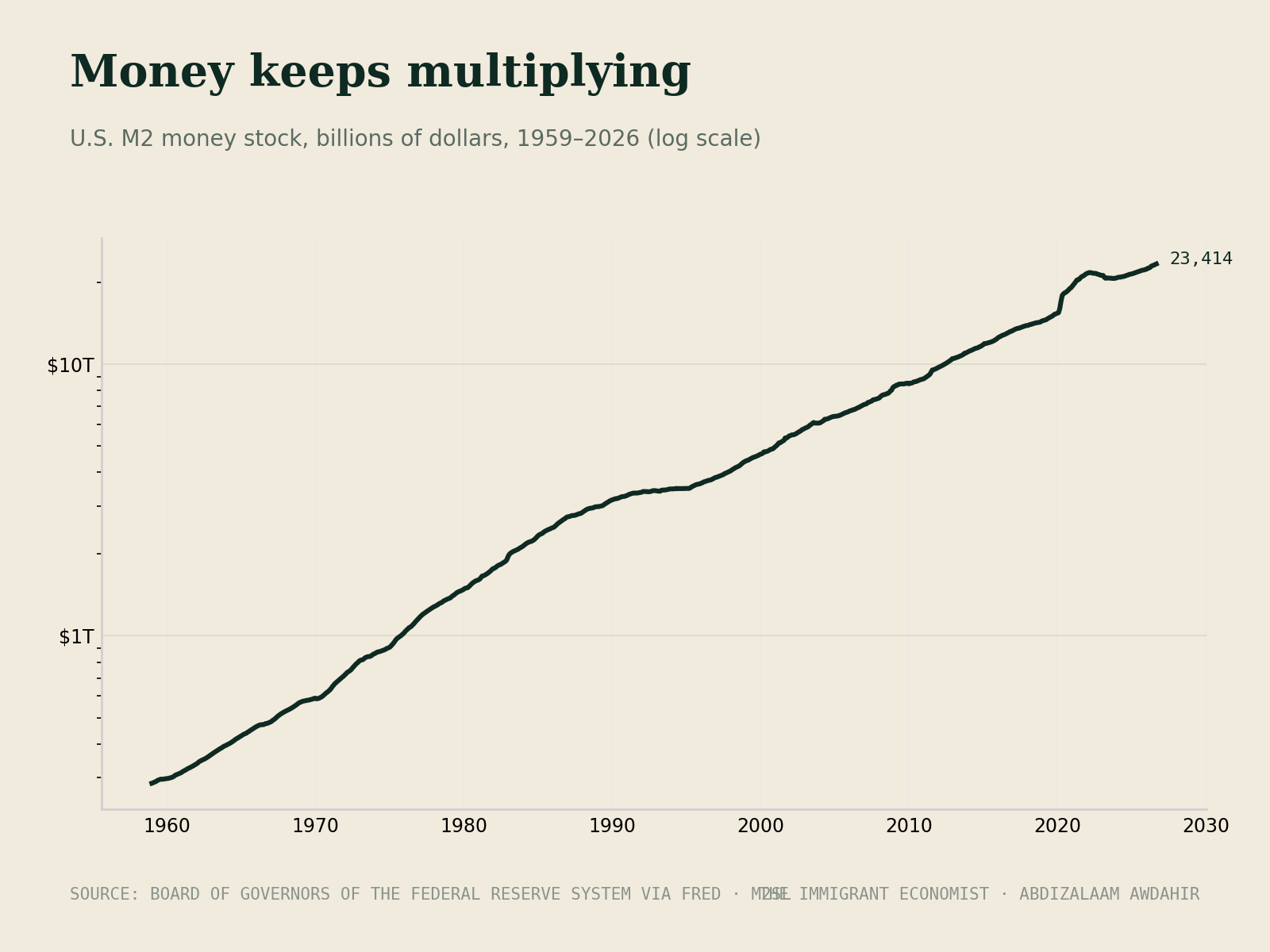
Here is a question that sounds childish until you try to answer it: what is the money in your bank account? Not what does it buy — what is it? It isn't gold. It isn't backed by gold, or silver, or anything you can touch. It is a number in a database, created by institutions, valuable only because everyone agrees it is valuable. Understanding this — really understanding it — is the single most important financial lesson a newcomer to the West can learn, because it explains why the strategy of 'work hard and hoard cash' is quietly guaranteed to make you poorer.
A five-minute history of money
Money began as a solution to an awkward problem: barter requires a 'double coincidence of wants' — I have grain and want shoes, you have shoes and want grain. Around 3000 BC, Mesopotamian temples solved this with clay tablets recording debts in barley and silver; the shekel was originally a unit of weight, not a coin. Around 600 BC, the kingdom of Lydia (modern Turkey) minted the first standardized coins, and money became portable. China took the next leap: by the Tang and Song dynasties, paper money circulated — value printed on mulberry bark, accepted because the state said so.
For most of history, paper money was a claim on metal: you could, in theory, redeem it for gold. After World War II, the 1944 Bretton Woods agreement anchored world currencies to the US dollar, and the dollar to gold at $35 an ounce. Then, on August 15, 1971, President Nixon closed the gold window. From that day, no major currency on earth has been backed by anything physical. Every dollar, euro, and Canadian dollar since is fiat money — money by decree, devoid of hard-asset backing, held up entirely by trust and law.
How money is actually created today
Most people imagine a government printing press. The reality is stranger. Central banks (the Federal Reserve, the Bank of Canada) create base money — but the majority of money in the economy is created by ordinary commercial banks, every time they issue a loan. When a bank approves your mortgage, it doesn't lend out someone's savings; it types new numbers into your account. New money, born as debt. Economists call this credit creation, and it's why the money supply expands relentlessly over time.
In crises, central banks add their own waves: after 2008 and again in 2020, 'quantitative easing' created trillions of new dollars electronically to buy bonds. More money chasing roughly the same amount of goods and assets has one predictable consequence — each unit of money buys less. That is inflation, and it is not an accident of the system. It is a feature of it.
Inflation: the tax nobody votes on
Purchasing power is what your money actually buys, and it melts like ice in the sun. At 3% annual inflation — roughly the long-run Western average — $10,000 kept in a checking account loses about a quarter of its purchasing power in ten years and nearly half in twenty-five. You can verify this against your own memory: compare the price of groceries, rent, or a car today with ten years ago. The number in the account stayed the same; the life it buys shrank.
For immigrants, this lesson arrives with extra force — and a cruel twist. Many of us come from countries where inflation was violent and obvious, so we learned to hold strong foreign currency as protection. 'Dollars in the mattress' was wisdom back home. But in a country whose currency is the stable one, hoarding that same currency means volunteering for the slow leak. Cash feels safe because its number never falls. Its value falls every single day.
Hard assets, explained simply
The escape from the leak is to own things whose value rises as money is created — hard assets. Think of it this way: when central banks print, the printer makes more dollars, but it cannot make more land, more gold, more great companies, or more Bitcoin. Scarcity is the whole game. Real estate is shelter plus land — finite, useful, and rentable; as money supply grows, both the property and the rent it commands tend to rise. Gold is humanity's 5,000-year-old insurance policy: it pays no interest and builds nothing, but no government can print it, which is why central banks themselves hoard it.
Stocks are the most powerful hard asset of all, though people rarely call them that: a share is partial ownership of a real business — factories, software, brands, cash flows — and great businesses raise prices with inflation, passing the melt through to you as the owner. And Bitcoin, born in 2009 in direct response to the bank bailouts, is the first digitally scarce asset: only 21 million will ever exist, enforced by code rather than promises. It is volatile — brutally so — and should be sized accordingly, but its thesis is the same as gold's, updated for the internet age.
Why this serves immigrants better than cash
The newcomer who keeps everything in cash is running two risks at once: the certain, slow loss to inflation, and the missed compounding of decades. The newcomer who converts surplus cash into hard assets — a broad halal index fund of productive companies (SPUS tracks large American companies screened for Islamic compliance), a first home when the numbers make sense, perhaps a measured allocation to gold or Bitcoin — owns things the printing press cannot dilute. Cash has exactly one job in this system: your emergency fund and short-term needs, kept in a riba-free Islamic savings account where any return comes as profit-sharing, not interest. Everything beyond that should be working in assets.
This is not speculation; it is the rational response to how money is actually made. The system rewards owners and quietly taxes holders. Once you see the 5,000-year pattern — every fiat currency in history has been debased, every scarce asset has outlived it — the decision stops being scary and starts being obvious. This thesis runs through everything I write here, and it is a cornerstone of the book I'm finishing now. Learn the rules of the new country, and the new country's system starts working for you.
Sources and further reading
Felix Martin, Money: The Unauthorised Biography (2013) — the clearest account of money as a social technology of trust. Niall Ferguson, The Ascent of Money (2008) — financial history from Mesopotamia to the mortgage crisis. Carmen Reinhart & Kenneth Rogoff, This Time Is Different (2009) — eight centuries of currency debasement and crisis. The Federal Reserve, The Fed Explained — how central banking and credit creation work today. Saifedean Ammous, The Bitcoin Standard (2018) — the hard-money case for Bitcoin; read critically, but read it. And the Federal Reserve Bank of St. Louis (FRED) — free data to watch purchasing power decline with your own eyes.
Enjoyed this? It's also on