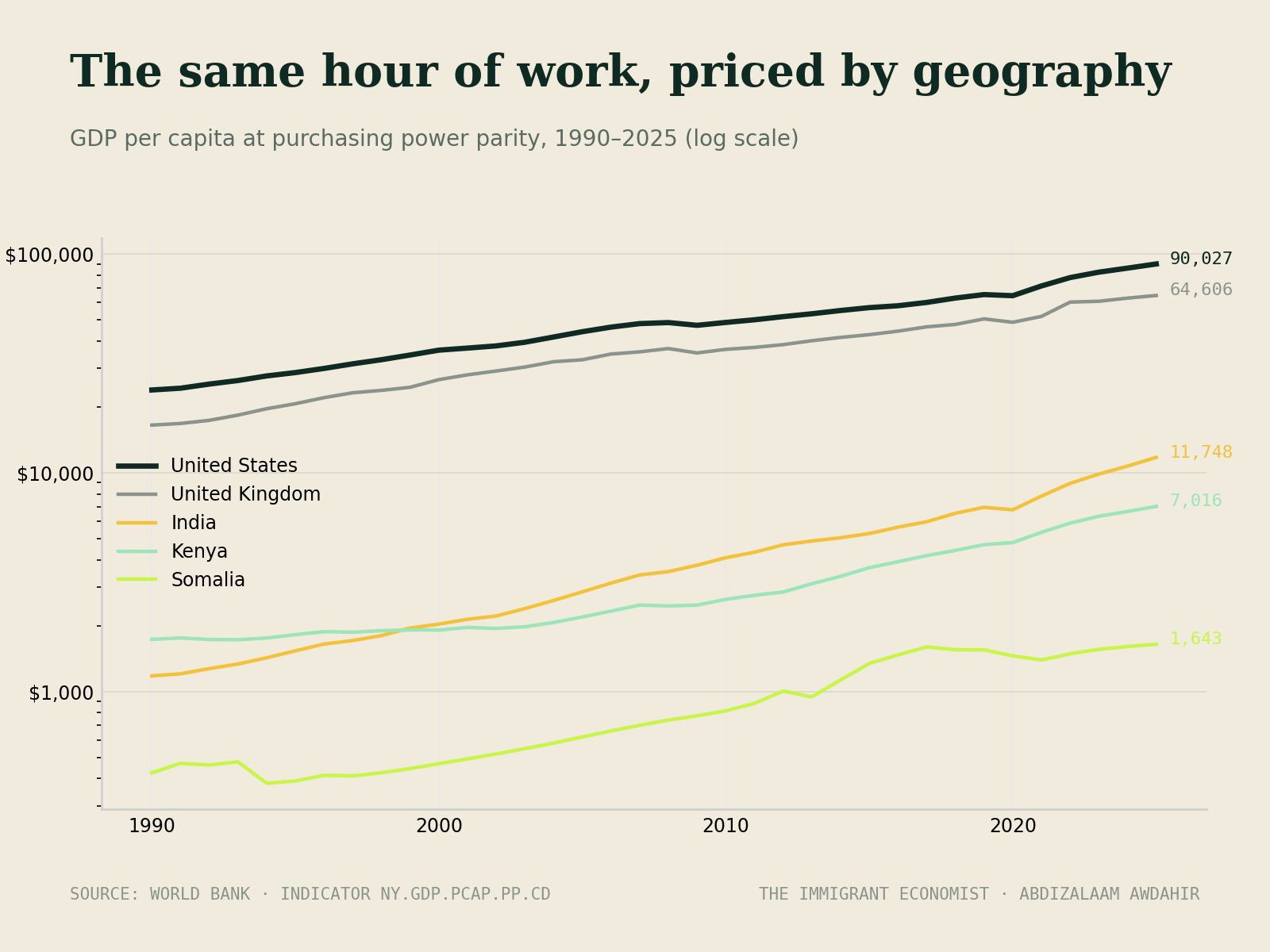
The Arrivals Hall
Watch the arrivals hall of any big airport long enough and you will see our whole story in one frame. A man wheels two suitcases through the sliding doors. One suitcase holds clothes. The other holds certificates, a rolled-up engineering degree, and a decision-making system he packed without knowing it — formed by the rules of a country he just left.
Ten years later, that man is either surviving or building. And here is the part nobody tells you at arrivals: the difference is rarely effort. We, the foreign-born, do not have an effort problem. We never did.
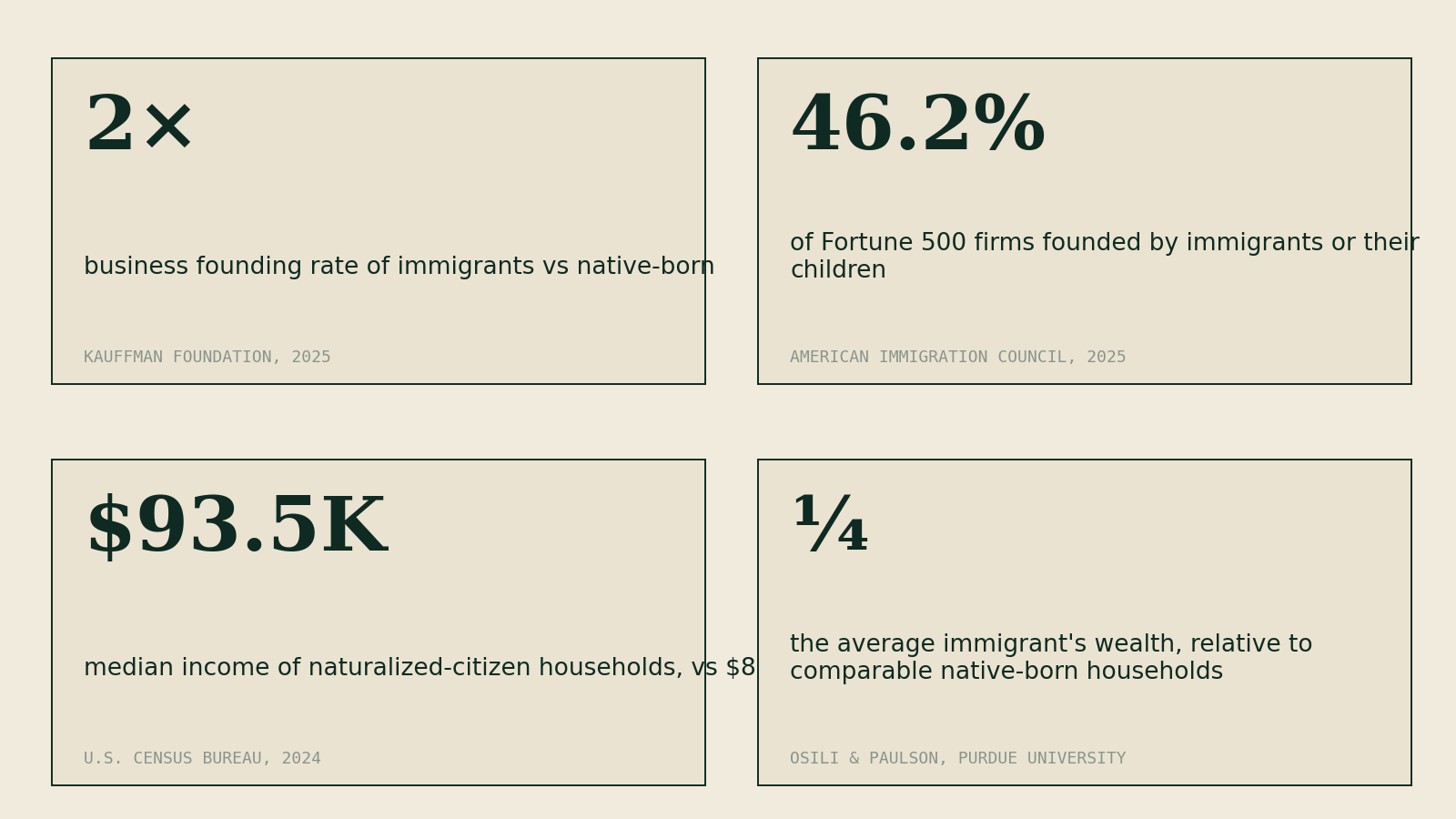
The numbers say so, loudly. In 2025, immigrants started businesses at twice the rate of the native-born — 0.60% of us launched a business every month, against 0.30% of them (Kauffman Foundation, 2025). The American Immigration Council found in 2025 that 46.2% of Fortune 500 companies — 231 of 500 — were founded by immigrants or their children. Naturalized-citizen households now out-earn native-born households, $93,530 to $84,490 median income (Census Bureau, 2024).
And yet. The average immigrant holds about one-fourth the wealth of a comparable native-born household (Osili & Paulson's research on immigrant finances). We own stocks at roughly half the native rate. We out-work, out-earn, and out-found — and still end up a quarter as wealthy.
So the gap is not effort. The gap is decision quality. Hard work is the engine. Decisions are the steering wheel. Too many of us are driving a powerful engine with no hands on the wheel — because nobody handed us the operating system this country runs on.
I am an economist and an immigrant, and I spent years asking the wrong question — why do immigrants work so hard? The better question is why we decide so defensively. The answer I kept finding came from an odd place: great investors. People like Buffett, Munger, and Grove think in mental models — reusable thinking tools that turn chaos into choices. Six of those tools fit immigrant life like they were designed for us.
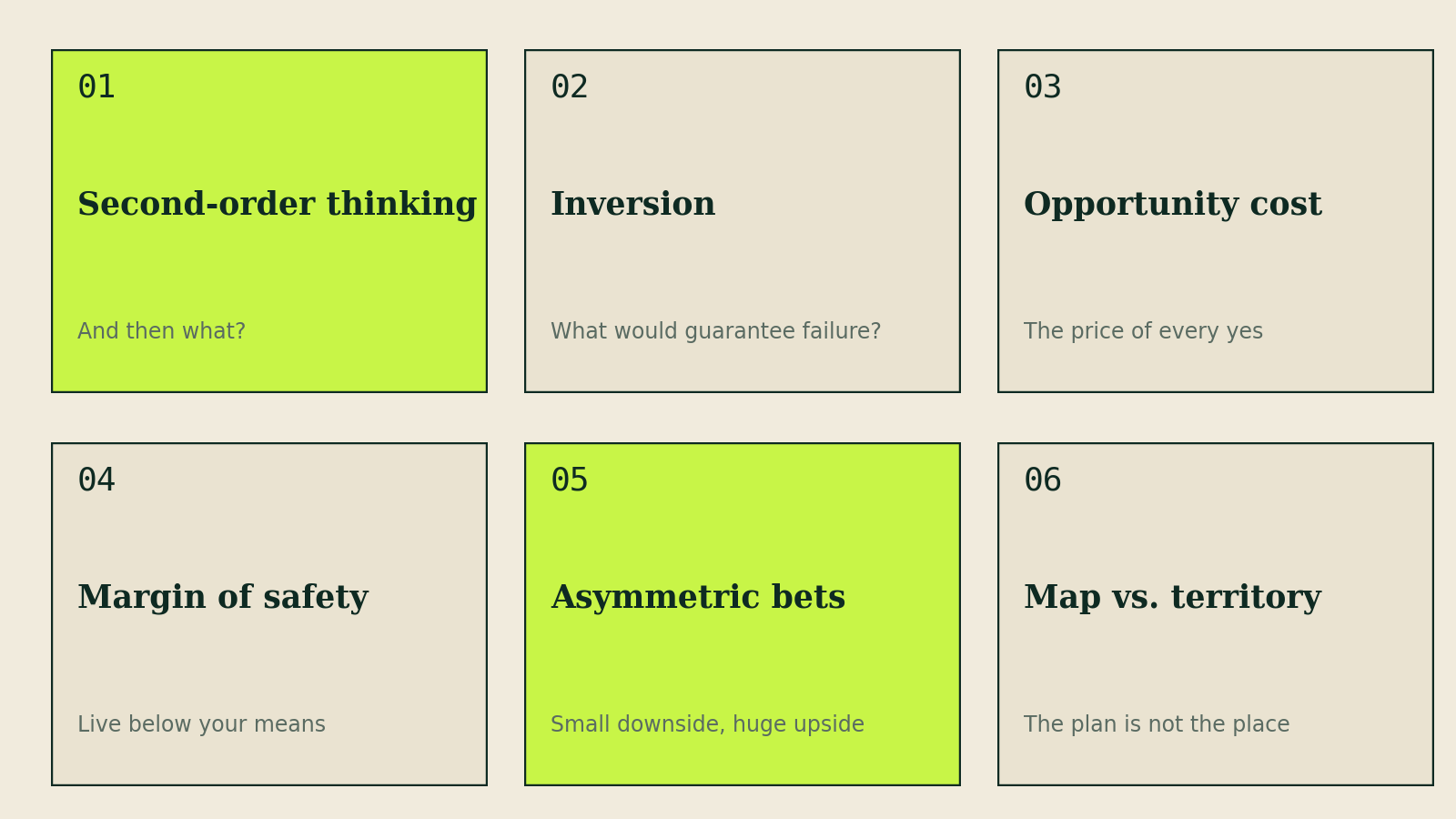
Here they are — six tools I stole from investors and smuggled across the border. For each one, I will give you what it is in plain words, why it fits our lives, and an immigrant who lived it. Steal them back.
Model 1: Second-Order Thinking — Ask "And Then What?"
Second-order thinking means looking past the first effect of a decision to the effects of the effect. First-order thinking asks: "Does this paycheck look good?" Second-order thinking asks: "And then what? What does taking this job do to my visa, my credentials, my kids' school district, my options in five years?"
Every big choice has a receipt. It just arrives years later, in a currency you did not know you were spending.
We are first-order thinkers by training, not by nature. When you arrive with $4,000 and no safety net, the visible paycheck beats the invisible compounding every time. The cashier job today beats the credential re-certification that pays off in three years. The cheap rent beats the pricier neighborhood near the good schools. The $500 remittance beats the $500 index fund.
That last one deserves a hard look. The World Bank reported that officially recorded remittances to low- and middle-income countries reached $685 billion in 2024 — and the true figure, counting informal channels, is higher. I am not against sending money home. I send money home. But second-order thinking forces the honest question: what does this $500 become in ten years? In my mother's hands, it becomes school fees this month. In an index fund, that same $500 invested once becomes maybe $1,000 toward a surgery later. Both are love. Only one compounds.
Satya Nadella lived the purest version of this model. In June 1994, he held a green card — the thing we all queue years for. But spouses of green-card holders faced waits of five years or more to join their partners, while H-1B workers could bring spouses quickly. So Nadella did something his colleagues at Microsoft thought was insane: he voluntarily gave up his green card and went back to H-1B status, so his wife Anu could join him immediately. In his memoir Hit Refresh, he remembers the office gossip: "Hey, there goes the guy who gave up his green card."
First-order thinking sees a man throwing away security. Second-order thinking sees a man who understood that a marriage is a compounding asset and an immigration status is just paperwork that can be re-earned. He was betting on the second and third effects, not the first. The man who "gave up his green card" is now CEO of Microsoft.
Try this: before any big decision, write the answer to "and then what?" three times in a row. Take the higher-paying warehouse job. And then what? No time to re-certify. And then what? Still in the warehouse in five years. And then what? The receipt arrives. Three lines of honest "and then what" will beat an hour of worrying.
Model 2: Inversion — Ask "What Would Guarantee Failure?"
Inversion is the strangest tool in the box, and maybe the most powerful. Instead of asking "How do I succeed?", you flip the question: "What would absolutely guarantee failure?" Then you avoid those things. The mathematician Jacobi said it first: invert, always invert. Charlie Munger made it famous.
This model fits immigrants like a glove, because we do not need to imagine failure. We have seen it. We know its smell. And we know, in our bones, that we are one bad decision from a very long fall — no family mansion to retreat to, no uncle who can wire money.
So invert. What guarantees immigrant failure? The catalog writes itself:
- Predatory loans. Payday lenders and buy-here-pay-here car lots charging 300% interest because you have no credit history and they know it.
- Immigration scams. The "notario" who is not a lawyer, the agent who guarantees a visa for a fee. Nobody can guarantee a visa. Nobody.
- Cosigning traps. The bank asks you to cosign your cousin's loan precisely because it doubts your cousin. Believe the bank's math.
- One-income fragility. One visa, one job, one layoff — and everything ends.
- Fear spending. Hoarding cash under the mattress because banks feel foreign, while inflation eats it quietly.
Notice what inversion does here. It skips the question of getting rich and goes straight to the question of never getting wiped out. Survival is a strategy. You cannot compound if you are broke. You cannot invest if you are deported, defrauded, or drowning in a 25% car loan.
Andrew Grove built an empire on this question. Born András Gróf in Budapest in 1936, he survived the Holocaust under a false name, fled the Soviet invasion in 1956, and arrived in America as a refugee. He worked as a busboy. Three years later he graduated first in his engineering class at City College of New York. In 1985, running Intel, he faced the company's death: Japanese competitors were destroying its memory-chip business. His famous move was pure inversion. He asked his co-founder, in effect: if the board fired us and brought in new management, what would they do? The answer: get out of memory chips. So they did it themselves, before ruin forced them — and bet everything on microprocessors. Grove had survived the Nazis and the Soviets. He knew the difference between a setback and annihilation, and he organized Intel around avoiding the second.
Try this: write your personal "guaranteed ruin" list — five things that would wipe out your family financially. Then audit your life against it once a year. Mine, the year I arrived, read: cosigned debt, no health insurance, all savings in one account, visa-critical money at risk, no written records of anything. Boring list. Boring is the point.
Model 3: Opportunity Cost — Every Yes Is a No
Opportunity cost is the price of the road not taken. When you say yes to one thing, you are saying no to the next-best alternative — and that rejected alternative is the true cost of your yes. The real cost of an MBA runs well past the tuition: the tuition plus two years of salary plus two years of whatever else you could have built.
Immigrants pay in two currencies at once: money, and years of life spent far from family. Every decision has a line in both ledgers. The stable job with the predictable paycheck? Money-ledger yes, life-ledger maybe — because the business you keep delaying is also compounding, invisibly, into the business you will never start.
Here is why this model matters more for us than for anyone: our time suddenly became expensive. Economists Clemens, Montenegro, and Pritchett studied the "place premium" — how much more the same worker earns just by crossing a border. Same person, same skills, same age: wages in the US run 2.6 times higher for a Mexican worker, 4.2 times for a Filipino, 7.9 times for an Indian, and over 16 times for a Nigerian, after adjusting for what money buys in each country. You did not get smarter at the airport. Your hours simply became worth more.
So spend them like they are worth more. Every overtime hour, every remittance dollar, carries a hidden price tag measured against what it could have built. This does not mean never work overtime and never send money. It means see the price tag. Most people shop their whole lives with the prices hidden.
Elon Musk ran this calculation brutally in 1995. He had emigrated from South Africa at 17, reached the US via Canada and the University of Pennsylvania, and arrived at Stanford to start a PhD in applied physics. He lasted two days. His reasoning: the internet was opening a once-in-a-generation frontier, and the opportunity cost of five years in a lab exceeded the value of the degree. He left, co-founded Zip2, and sold it to Compaq for $307 million in 1999. The degree would always be there. The window would not.
And the numbers suggest immigrants are unusually willing to pay the opportunity cost of entrepreneurship. The National Foundation for American Policy reported in 2026 that immigrants founded or co-founded 59% of America's billion-dollar startups — 455 of 775 — nearly a quarter of them founded by people who first arrived as international students.
Try this: for your next big yes, write down the best thing you are saying no to. Give it a dollar figure and a year figure. If the no looks more valuable than the yes, you have your answer.
Model 4: Margin of Safety — Plan for Your Own Mistakes
Margin of safety is the oldest rule in investing: never pay full value, never stretch to the last dollar, always leave room for your own errors. Benjamin Graham taught it as buying a dollar for fifty cents. In plain life terms, it means this: build your plans so that being wrong does not destroy you.
For immigrants, this model is not about stocks. It is about oxygen. The Federal Reserve's 2025 household survey found that only 63% of US adults could cover a $400 emergency with cash or its equivalent — meaning 37% could not, and 13% could not pay it at all. Only 55% had three months of expenses set aside. That is the general population. Now subtract the family safety net. When a native-born American goes broke, there is often a parent's spare room, an aunt's couch, a childhood friend's loan. When we go broke, the spare room is eight time zones away.
For us, the runway is the family. The emergency fund is not a financial product. It is the aunt, the cousin, and the church basement, rebuilt out of your own paychecks.
So the rules of thumb write themselves. Keep a six-month runway before any big risk — quitting the job, starting the business, sponsoring a relative. Never invest money your visa depends on; if losing it would force you onto a plane, it does not belong in the market. And never sign a lease, loan, or partnership that only works if everything goes right. Everything never goes right.
Here is the part nobody expects: margin of safety is a confidence machine. Fear makes you accept bad deals — the underpriced salary, the landlord's illegal terms — because you cannot afford to walk away. A runway converts fear into patience. The woman with eight months of expenses in the bank negotiates differently. She can hear an insulting offer and say the most expensive word in English: no.
Hamdi Ulukaya ran his entire company on this principle. A Kurdish immigrant from Turkey who arrived in 1994, he spotted a junk-mail flyer in 2005 advertising a shuttered 84-year-old yogurt plant Kraft was abandoning in upstate New York. He fished the flyer out of the trash and bought the plant with a Small Business Administration loan — against his attorney's advice. Here is the margin-of-safety part: no gleaming new facility. He bought a closed factory at scrap value, kept costs brutally low, and grew Chobani without betting money he did not have. Downside capped: an old plant and a government-backed loan. Upside: roughly $1.5 billion in annual revenue by 2016. In April 2016 he gave 10% of the company to his 2,000 full-time employees, from his own stake. Margin of safety, it turns out, makes you brave enough to be generous too.
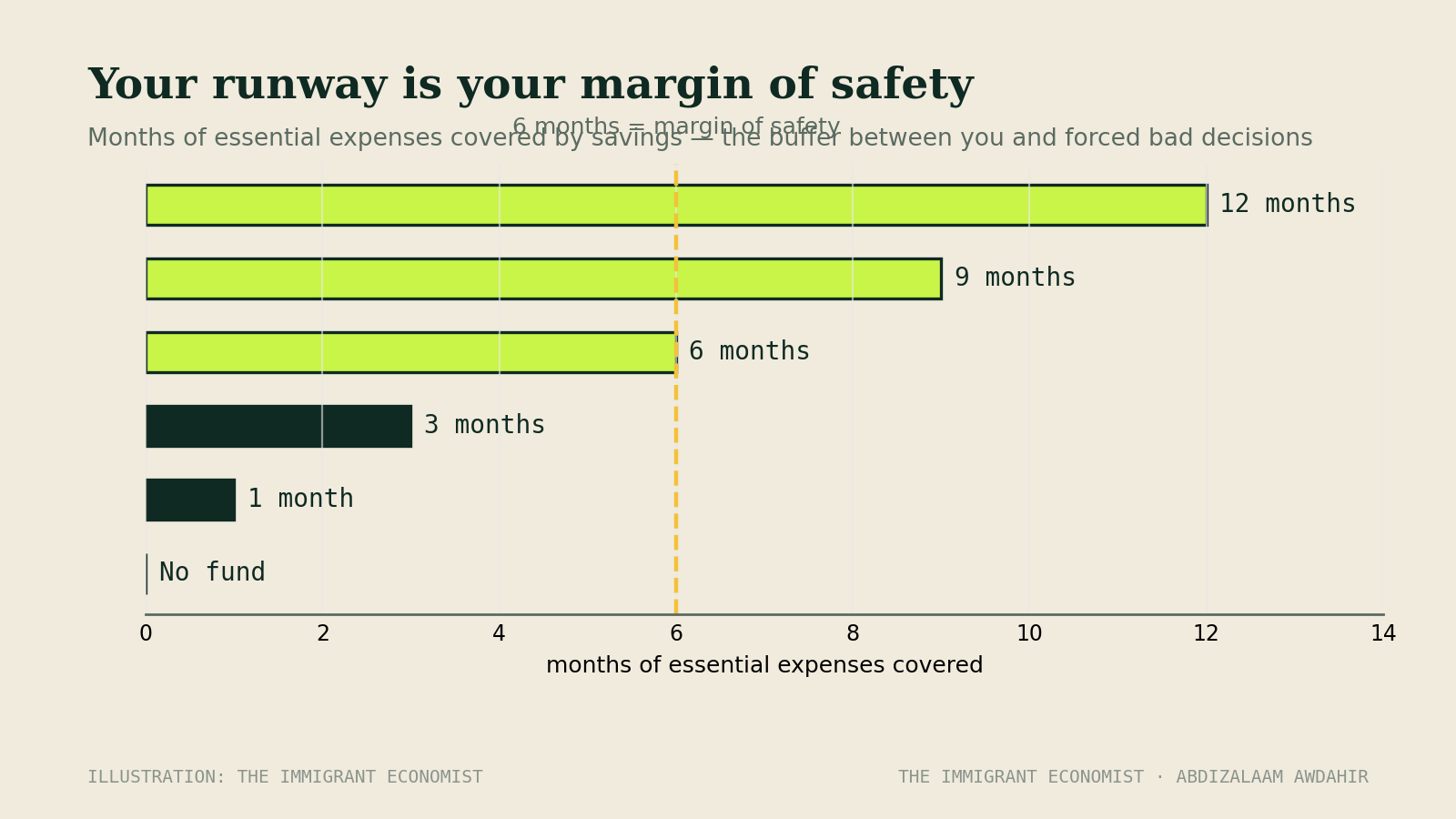
I have watched too many immigrant families learn this model the hard way, which is why my book Modern Money devotes a full chapter to building a runway — the chapter I would read first.
Try this: open a separate savings account this week — a boring one, at a real bank — and name it "Runway." Automate even $50 a month into it. You are not saving money. You are buying the right to say no.
Model 5: Asymmetric Bets — Risk Little, Win a Lot
An asymmetric bet is one where the downside is small and capped, but the upside is large and open. Lose a little if wrong, win a lot if right. Investors hunt for these. Immigrants, oddly, are surrounded by them — and walk past most.
Look at the asymmetries we already hold. A night course costs $500 and some tired months; if it works, it re-prices your whole career. A side business costs weekends and a few hundred dollars; if it works, it becomes the main business. Speaking two languages costs us nothing now and pays forever. And the biggest asymmetric bet of all — leaving home — we already won. We risked comfort for a place premium of two, four, eight, sixteen times our wages. We are, by biography, people who take large risks for large payoffs.
Which makes the next fact genuinely strange. When Osili and Paulson examined financial data, they found that about 20% of native-born Americans owned stocks (23% in a later survey) while only 8.6% to 11% of immigrants did. Read that slowly. We take the biggest life risk a human can take — crossing the world — and then become conservative exactly where risk is rewarded. Lions at the border, mice at the brokerage.
I understand why. Markets feel foreign, literally. Osili and Paulson found that immigrants from countries with weaker, less trustworthy institutions participate less in US financial markets even at the same wealth and education levels. The distrust travels with us, packed next to the certificates. But distrust is not a strategy. It is a mood with a cost.
Jensen Huang shows what the asymmetric bet looks like from the inside. He came from Taiwan as a boy, cleaned bathrooms at a Kentucky boarding school, washed dishes at Denny's, and co-founded NVIDIA in 1993. By 1997 the company was dying: its first chip had flopped, half the staff was laid off, about one month of payroll remained. Huang bet everything on a new chip, the RIVA 128, tested entirely in simulation, before any physical chip existed. If it failed, NVIDIA died — downside capped and total. If it worked, the company lived. It sold roughly a million units in four months. Then he spent a decade funding CUDA, an unprofitable software bet Wall Street hated, until it became the foundation of the entire AI boom.
Or take Jan Koum, who arrived from Soviet Ukraine at 16 and swept grocery-store floors while his mother collected food stamps. Rejected for a job at Facebook, he nearly folded his tiny messaging app in 2009; his co-founder Brian Acton talked him out of quitting. Koum kept WhatsApp brutally lean — no ads, no games, no gimmicks. Tiny costs, open upside. In February 2014 Facebook bought it for $19 billion, and Koum signed the deal on the door of the social-services office where he had once queued for food stamps. Forbes documented that detail. You could not invent a better one.
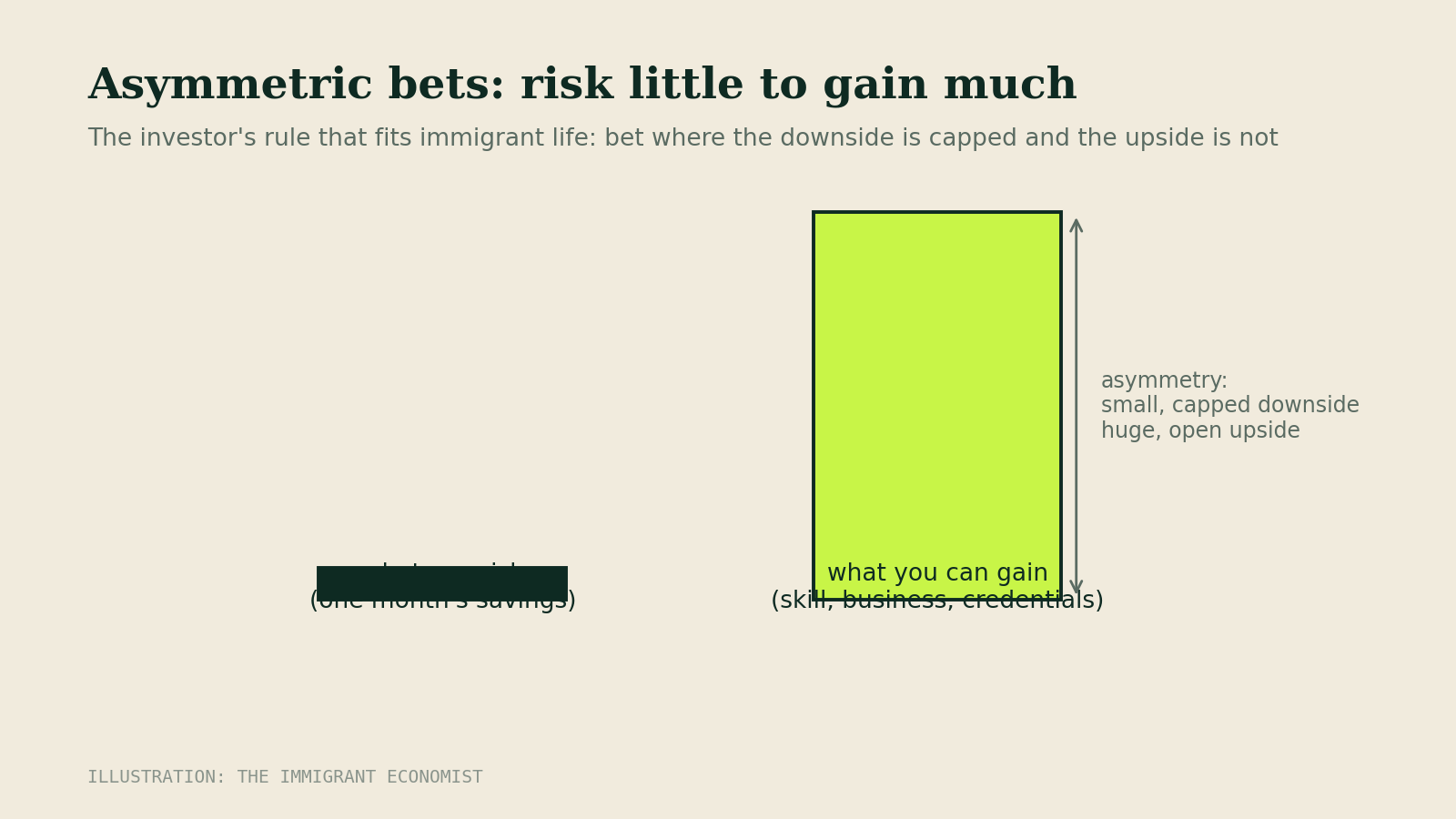
Try this: list three bets available to you this year where the loss is capped and the gain is open — a course, a certification, a side business, a first $100 in an index fund. Take one. The asymmetry is already yours; the bet is just claiming it.
Model 6: Map vs Territory — Your Model of the West Is Not the West
Here is the deepest model, and I saved it for last on purpose. The map is not the territory: the picture in your head of a place is not the place. We each arrive carrying a map of how money, work, debt, and status operate — drawn by our home country. Some of that map is treasure. Some of it is a map of a country we no longer live in.
The imported assumptions misfire in predictable ways. Cash is safe — true where banks collapse; here, cash just shrinks with inflation. Debt is shameful — true where debt meant the moneylender; here, never borrowing means never building a credit score, which means paying more for everything later. Government jobs are the only safe jobs — in America, "safe" lives in skills, savings, and mobility, not in a ministry desk. The lawyer or agent knows best — sometimes they are notarios in a suit. Status means a new car and a big watch — the home-country status game, played at full price, in a country where the real wealth game is unglamorous: index funds, retirement accounts, paid-off houses.
The territory has rules, and nobody hands you the rulebook at arrivals. A credit score — a three-digit number that decides what interest you pay — builds only through borrowing and repaying on time. A 401(k) is a retirement account your employer may match with free money many of us leave uncollected. A Roth IRA lets investments grow untaxed. None of this is complicated. All of it is undocumented in the maps we brought.
Osili and Paulson found the fingerprints of the old map in the data: immigrants from countries with weak institutions use banks and markets less, even decades later — unless they have lived in the US more than 28 years, at which point the effect fades. Twenty-eight years is a long time to let a stale map steer. The good news inside that finding: maps can be redrawn.
Sundar Pichai redrew his in public. He grew up in a two-room apartment in Chennai, sleeping in the living room; his plane ticket to Stanford cost more than his father's annual salary. At Google, Pichai became convinced the company should build its own browser — when Microsoft's Internet Explorer dominated the web and the idea looked arrogant. His map said: winning means out-arguing people. The territory of American corporate culture said otherwise. So he did not fight; he persuaded — patiently, repeatedly, until Larry Page and Sergey Brin backed Chrome themselves. Chrome became the world's most-used browser, and the persuader became CEO of Google, then of Alphabet. He did not abandon his map. He corrected it against the actual terrain.
Try this: once a year, audit your map. Pick one belief about money that you brought from home and ask: is this true here, now, in this country? Keep the ones that survive the question. Retire the ones that do not, with gratitude — they kept your parents safe. They are just not the territory anymore.
The Tool: The Immigrant Decision Tree
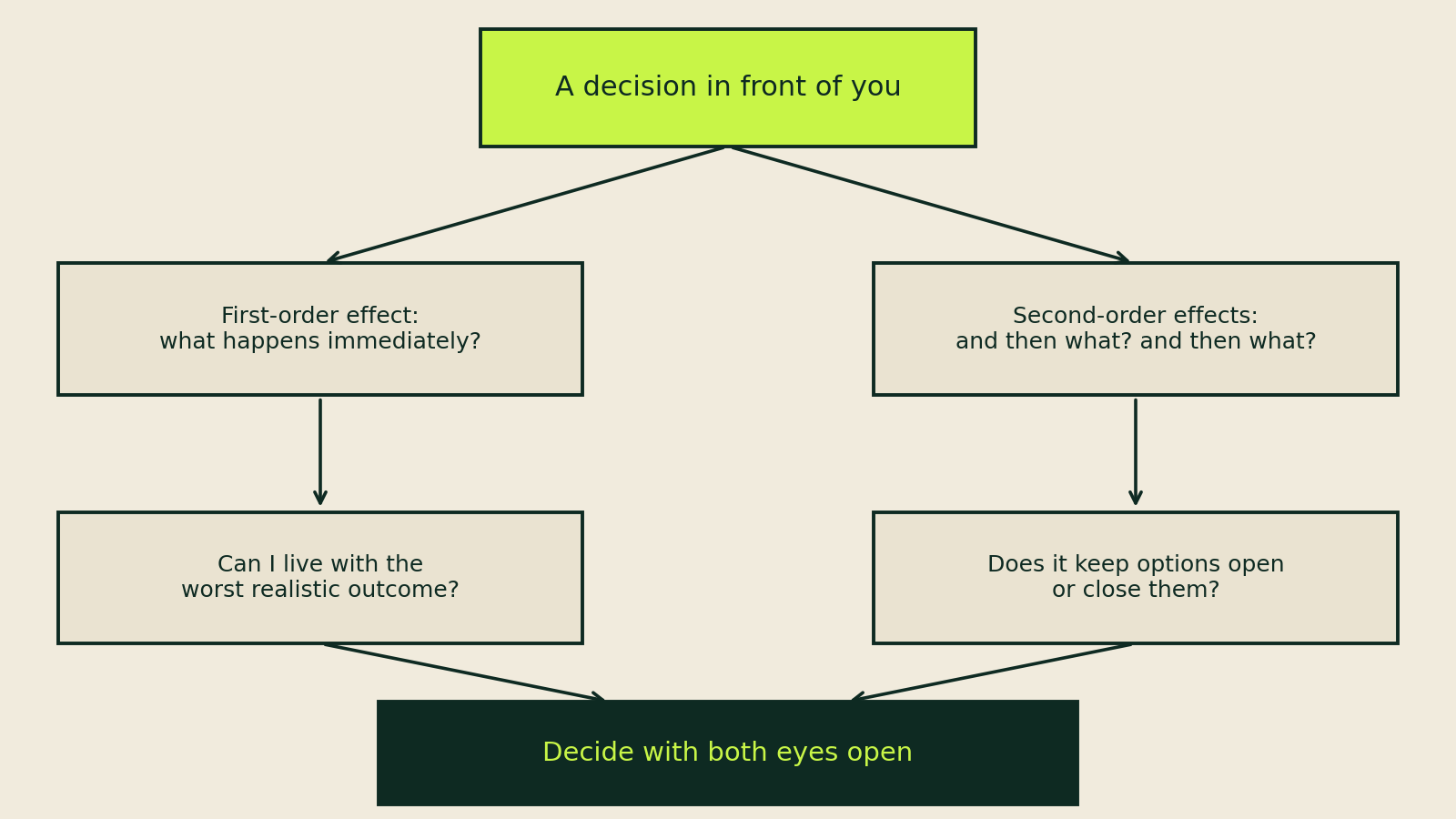
Six models are a lot to hold in your head at a car dealership at 8 p.m. So I compressed them into one flowchart — the Immigrant Decision Tree — five questions you run any big decision through, in order. Here is how it works on a real one: Should I send $500 home every month, or invest it?
Question 1 — Ruin check (Inversion). Does either choice risk wiping me out? Sending $500 when I have no emergency fund means one car repair puts me on a payday loan. If my runway is under six months, the answer is: send less, build the runway first. Not zero. Less. The enemy here is fragility, not love.
Question 2 — What happens next, and next (Second-order). The $500 sent becomes school fees this month — gone, and needed again next month. The $500 invested every month becomes maybe $86,000 in ten years at average market returns. One path repeats forever. One path eventually ends the need for the path.
Question 3 — The hidden no (Opportunity cost). What is the best thing this $500 is saying no to? A certification? A down payment? My mother's medication fund? Name it. Only then decide.
Question 4 — Room for error (Margin of safety). Can I still do this if my hours get cut or the rent rises? If the plan only works when life behaves, shrink it until it works when life does not.
Question 5 — Capped downside, open upside (Asymmetry). Investing $500 a month: worst realistic case, it loses value for a while; best case, it compounds for thirty years. Sending it: capped upside, endless repetition. And behind both sits the map question — am I choosing this because it is right here, or because it was right there?
Most real decisions die at Question 1, which is the point. The tree has one job: keep you solvent while you become brilliant.
The Landing
Here is what I want you to carry out of this essay, heavier than any single model: you have already done the hardest part.
Think about what the crossing actually was, in the cold language of this essay. It was a massive asymmetric bet — capped comfort traded for open upside. It was second-order thinking — suffer now so the children compound later. It was margin of safety — save and double-check everything, because nobody was coming to catch us. We did not have the vocabulary. We had the practice. Our families ran this playbook without knowing it was a playbook.
The research on mobility proves it. Abramitzky, Boustan, and their colleagues found that children of immigrants who grew up in the poorest quarter of American households end up near the middle of the income ladder as adults — out-climbing the children of the US-born from the same starting line — and that the single biggest driver is a decision: immigrant parents move to where the opportunities are. Not luck. A decision. Made at a kitchen table, probably over a map, probably in two languages.
One honest caveat belongs here. For every Nadella whose second-order bet paid off, there are immigrants whose careful bets failed anyway. These models improve your odds; they do not guarantee outcomes.
That is the inheritance that matters. The second generation does not just inherit our money — frankly, on current wealth numbers, there is not enough of it. They inherit our decisions. Decision quality is learnable, teachable, and inheritable. It is the one asset no border can tax.
Read further: Modern Money by Awdahir Everything in this essay — the runway, the decision tree, the maps we bring and the territory we actually live in — is one chapter of a longer playbook I wrote specifically for immigrants. No jargon, no lectures, no hype: just the full system for earning and growing money in a country whose real rules nobody explains to us. If this essay helped, the book is the whole toolbox.
Life serves up roughly five big decisions a year — a job, a loan, a move, a bet. Twelve years of building is sixty of them.
We crossed an ocean on one good decision. Imagine what sixty more will do.
Awdahir is The Immigrant Economist — an economist, an immigrant, and the author of Modern Money. He writes at immigranteconomist.com.
Evidence and further context
- Kauffman Foundation, 2025 Early-Stage Entrepreneurship National Report (2026) Reference supplied by the author.
- American Immigration Council, Nearly Half of Fortune 500 Companies in 2025 Were Founded by Immigrants or Their Children (2025) Reference supplied by the author.
- U.S. Census Bureau, Income in the United States: 2024, P60-286 (2025) Reference supplied by the author.
- Osili & Paulson, immigrant wealth and financial-participation research (2008/2009), reviewed in Journal of Population Economics (2015) Reference supplied by the author.
- Osili & Paulson, What Can We Learn about Financial Access from U.S. Immigrants?, World Bank Economic Review (2008) Reference supplied by the author.
- World Bank, Migration and Development Brief and blog: remittances to low- and middle-income countries reaching $685 billion (2024) Reference supplied by the author.
- National Foundation for American Policy, Immigrants and U.S. Billion-Dollar Companies (2026) Reference supplied by the author.
- Federal Reserve Board, Economic Well-Being of U.S. Households in 2025 (2026) Reference supplied by the author.
- Clemens, Montenegro & Pritchett, The Place Premium, World Bank (2008); updated country ratios (2016) Reference supplied by the author.
- Clemens, Montenegro & Pritchett, The Place Premium, World Bank (2008); updated country ratios (2016) — additional source Reference supplied by the author.
- Abramitzky, Boustan, Jacome & Pérez, Intergenerational Mobility of Immigrants in the US over Two Centuries, NBER Working Paper 26408 Reference supplied by the author.
- Satya Nadella green-card story: Hit Refresh (2017); Fortune (2026) Reference supplied by the author.
- Andrew Grove: Stanford Archives, Andrew S. Grove Papers; NYT obituary Reference supplied by the author.
- Elon Musk's Stanford departure and Zip2 sale: Benzinga (2026) Reference supplied by the author.
- Hamdi Ulukaya: Forbes profile (2017) Reference supplied by the author.
- Jensen Huang / NVIDIA history: Founders Library; cybernews (2024) Reference supplied by the author.
- Jensen Huang / NVIDIA history: Founders Library; cybernews (2024) — additional source Reference supplied by the author.
- Jan Koum: Parmy Olson, Forbes (2014) Reference supplied by the author.
- Sundar Pichai: Business Today profile (2024) Reference supplied by the author.
A quick note, always worth repeating: this is my personal journal, not financial advice. My positions are sized to survive being wrong, and everything I invest in passes Sharia screening — your situation is yours, so please do your own homework before acting on anything here.
This note is also discussed on