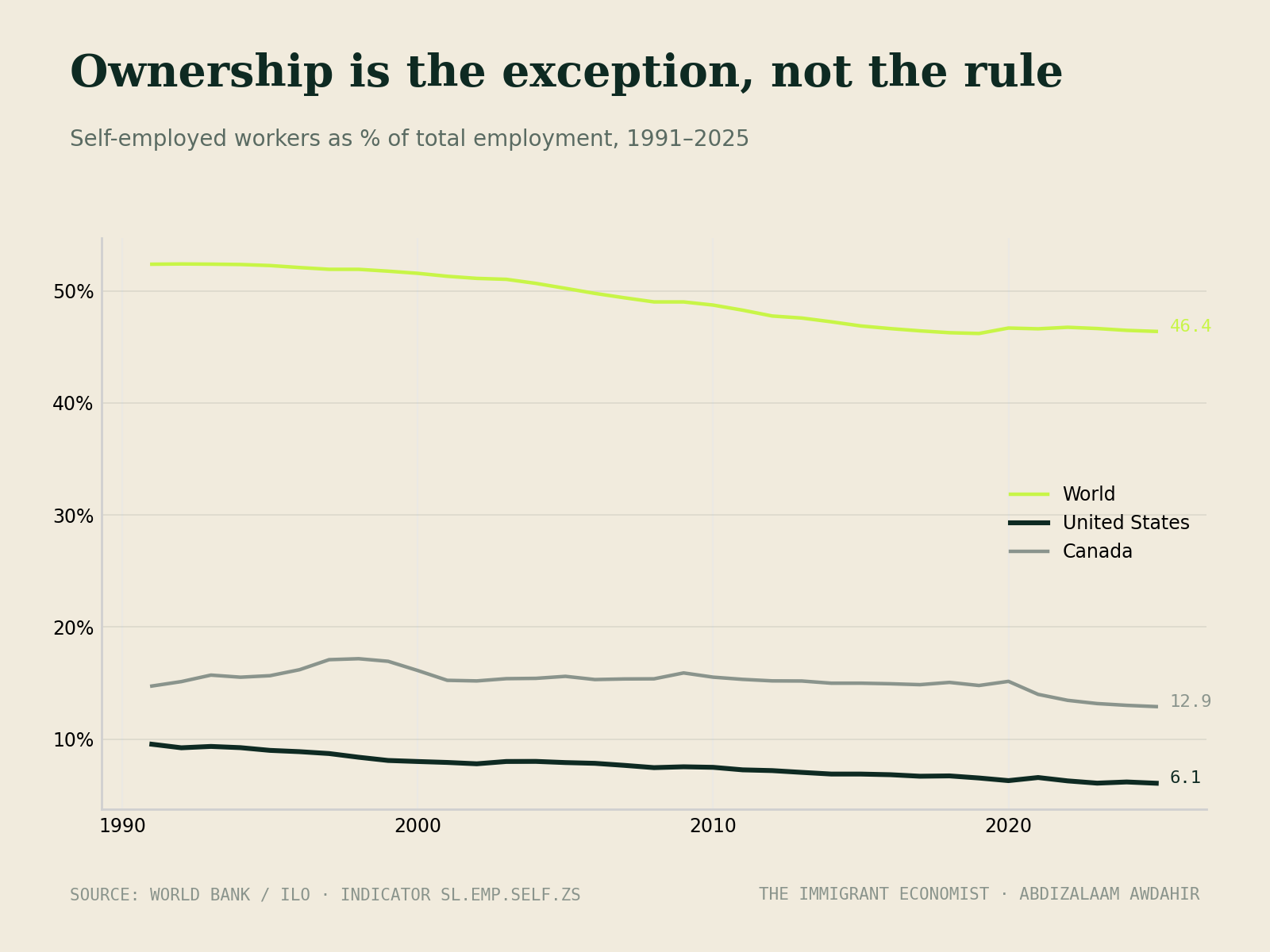
There is a joke in immigrant circles that is not really a joke: we don't have a work ethic, we have a work terror — the deep, inherited knowledge that nobody is coming to save us. That drive built our families' survival back home, and it powers us here through double shifts, night classes, and weekend jobs. But here is the question almost nobody asks us: is all that effort building your asset, or only someone else's? A salary is rented security — it stops the day you stop. An asset pays while you sleep. The side hustle, done right, is the bridge between the two.
I want to be careful with this topic, because the internet has poisoned it. 'Side hustle' now conjures dropshipping gurus and rented Lamborghinis. That is not what this essay is about. What I want to walk you through is the slower, older, proven path: using skills you already have, evenings and weekends you can spare, and the specific advantages immigrants carry — to build a second income that can, over years, quietly become a first one. It isn't glamorous, but it works, and I'd rather give you something that works.
Your hidden advantages
Before the how, the why-you. Newcomers underestimate three assets they walk in with. The first is languages: every language you speak is a market — translation, tutoring, community services, businesses desperate to serve customers in their mother tongue. The second is network across borders: you understand two countries' products, prices, and needs, which is the entire foundation of trade; many successful immigrant businesses are simply bridges between here and there. The third is grit itself: the willingness to do unglamorous work well and show up every week is rarer than talent, and clients pay for it.
There is also a fourth advantage nobody mentions: you know how to live below your means. A side business in its early years survives or dies on whether the household can tolerate lean months. Families who need every dollar of lifestyle cannot experiment; you can. The same skill that protects your budget protects your business.
Start with skills, not schemes
The strongest first side hustles sell what you already know. The accountant from Lagos does books for small businesses in Toronto. The nurse from Manila tutors nursing students online. The engineer from Lahore does CAD drafting on contract. The cook from Guadalajara caters weekend events. Notice the pattern: no inventory, no large upfront cost, no course to buy — just an existing skill, sold into a market that pays better here than it did there. This is the barbell logic applied to career: your job is the safe end, and the side hustle is the small, capped-cost bet with open upside.
Getting the first client is the part that feels impossible, and it is simpler than it looks. Tell your community explicitly what you do — most first clients come through people who already trust you. Put your service where buyers look: freelance platforms for digital skills, local groups and community boards for local services. Do the first few jobs at a fair-but-modest price, overdeliver, and collect reviews like gold. Ten good reviews are worth more than any advertisement. Then raise your prices. Almost everyone waits too long to raise prices; the market will tell you, and a few 'no's are information, not insult.
The regulated profession problem
Now the hard truth many of you already know: if you were a doctor, engineer, nurse, teacher, or accountant back home, your credential may not transfer cleanly. This is one of the deepest frustrations of immigrant life — the surgeon driving for a ride-share app — and I will not insult you by pretending it is simple. But there is a strategic way through it, and it matters too much to skip.
First, learn the licensing pathway early — every regulated profession in the US and Canada has a published process: credential evaluation, exams, supervised practice, sometimes bridging programs at colleges designed exactly for internationally trained professionals. Start it now, even if slowly, because the clock passes anyway; in three years you can either be three years into the process or three years older with nothing started. Second, while the process runs, work adjacent to your field: the internationally trained nurse works as a health aide or instructor; the engineer as a technician or project coordinator. Adjacent work keeps your skills warm, builds local references, and pays better than generic survival jobs. Third, count the cost honestly — exams, evaluations, and courses add up — and budget for them as what they are: an investment with one of the highest lifetime returns available to you. Your credential, once converted, is an asset that pays for forty years.
From side to main — and the rules that protect you
How does a side hustle become the main one? Slowly, and on evidence. The rule I teach: let the side income prove itself for a year — real revenue, real repeat clients, not one lucky month — and consider the leap only when it consistently replaces a meaningful share of your salary, or when it is clearly capped by your available hours. Keep the job while the bridge is being built. The person who quits on hope is gambling; the person who quits on a year of receipts is making a business decision.
And some guardrails, learned from watching families do this well and badly. Keep the money separate from day one — a separate account for the side income, so you always know the truth about whether it works. Remember taxes: side income is taxable, and in both countries you should set aside a portion of every payment so April holds no surprises. Check your employment contract for conflicts before you start. Protect the downside: no big loans, no leased equipment, no inventory you cannot afford to lose — the hustle should be able to fail without touching your family's foundation. And pace yourself: the hustle that costs you your health or your family is not building a better life, it is just a second cage.
What this is really about
I will tell you why I care about this topic enough to make it a pillar of this site. Ownership changes how a person walks through the world. The immigrant with only a salary is one layoff from crisis; the immigrant with a salary, investments, and a small growing business is antifragile — each shock pushes work toward the doors that remain open. That is the real product of the side hustle. Not the extra money this month, though that helps. The product is the day you realize you are no longer trapped — that your effort is compounding into something with your name on it.
Start absurdly small. Sell the skill once. Then twice. Raise the price. Tell your community. Keep the receipts — literally and figuratively. Our grandparents crossed oceans with less proof of concept than that. The grit is already in you. This is just pointing it at something you own.
Enjoyed this? It's also on