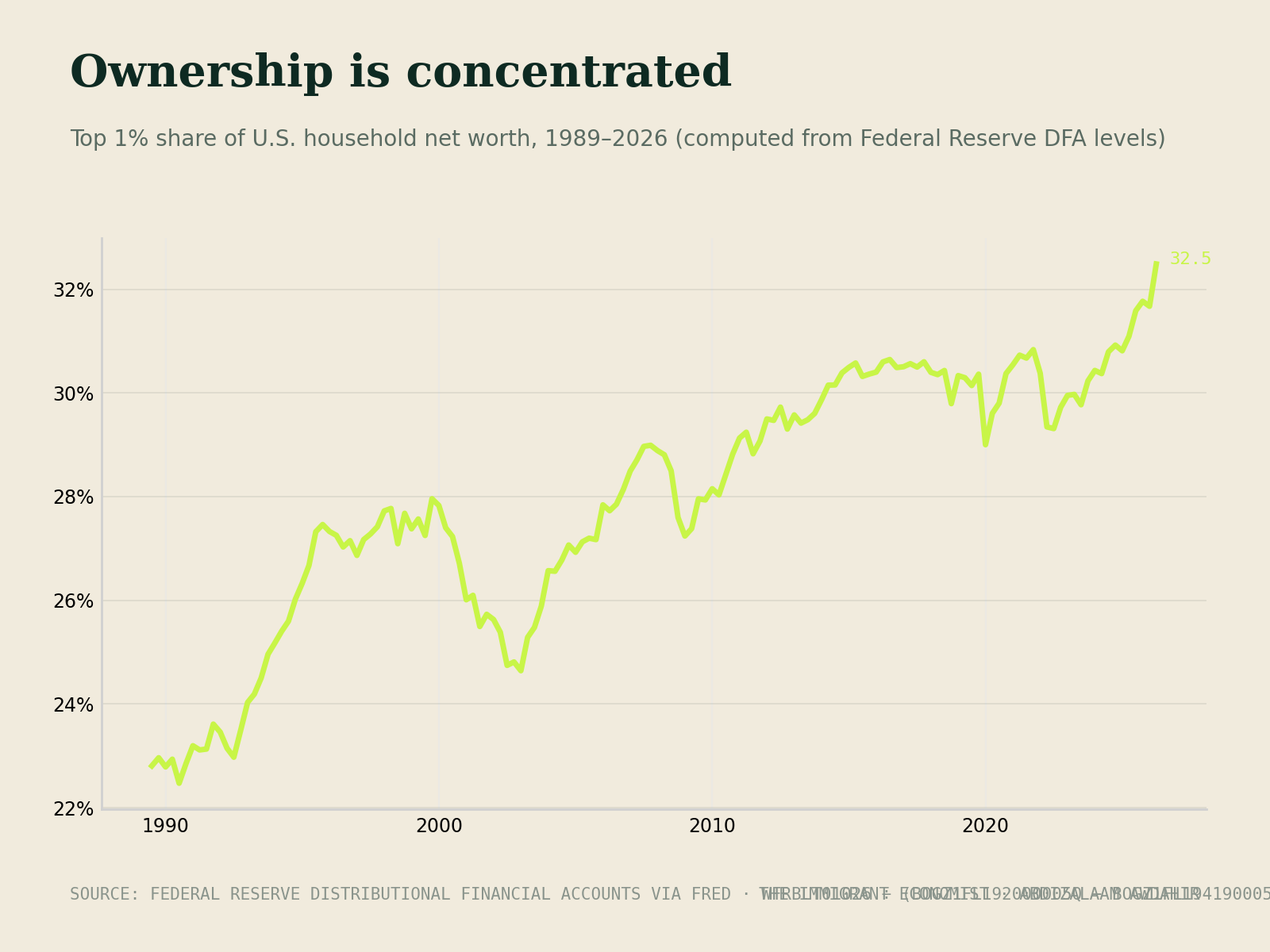
Something has changed inside the world's most boring investment, and most people haven't noticed. The whole pitch of a broad index fund — and I've made this pitch myself, many times, in the essays on this site — is that you own hundreds of companies, so no single one can hurt you. That's still more true than false. But it's less true than it used to be, and I think it's worth sitting down and saying plainly.
The biggest companies in the major indices have grown so large that a small group of them now carries an outsized share of the whole index's weight. When those few names have a bad stretch, the 'diversified' index feels it like a concentrated bet. You're not imagining it if your boring fund has started moving like a tech stock. In a real sense, it partially is one.
How it happened, in plain terms
Market-cap weighting is a beautiful, humble idea: own everything, in proportion to its size, and never pretend you know more than the market. The catch is that when a few winners run for years, the index automatically buys more and more of them. The mechanism has no opinion. It just follows the money up. During the long climb, this feels like genius — your index is loaded with the winners. At the turn, the same mechanism means you're maximally exposed to exactly the names everyone already owns.
I'm not telling you this to scare you out of index funds. I'm still a believer, and my own core money stays in them. But I've started treating concentration as a number I check, the way you'd check the weather before a long drive. What share of the fund is the top ten holdings? If that share has climbed a lot, I mentally relabel the fund: this is a great investment that is also, partly, a bet on a handful of companies continuing to be loved. Knowing that changes how much surprise I'm willing to tolerate.
The halal angle, because it matters to me
For those of us investing through Sharia-screened funds — SPUS, HLAL, and the like — there's an extra wrinkle worth knowing. Screening removes conventional banks and interest-heavy companies from the basket, which is exactly what we want. But it also means the remaining fund can lean even more heavily toward the sectors that pass the screen, which in practice often means technology. So the concentration question isn't academic for us; it's doubled. The screen purifies the money, and it reshapes the basket, and we should hold both truths at once.
What do I do about it? Three things, none of them clever. I check the top holdings of my funds a couple of times a year — it takes ten minutes on the provider's website. I keep my total position sized so that even a deep drawdown in the big names is survivable, because drawdowns in loved stocks are a law of nature, not a possibility. And I let time in the market do the heavy lifting, because the answer to concentration risk, for a long-horizon investor, is mostly patience — the giants of one decade are rarely the giants of the next, and the index will rotate for me without my lifting a finger.
The honest bottom line
Concentration is the tax you pay for the market's winners having won. It's not a flaw in the index idea; it's a feature that occasionally sends a bill. My advice is the boring one: know what you own, check the top ten once in a while, size your position so a storm in the giants is an inconvenience rather than a catastrophe, and then go live your life. The index is still the best game in town. I just want you playing it with your eyes open — that's all this note is for.
A quick note, always worth repeating: this is my personal journal, not financial advice. My positions are sized to survive being wrong, and everything I invest in passes Sharia screening — your situation is yours, so please do your own homework before acting on anything here.
This note is also discussed on